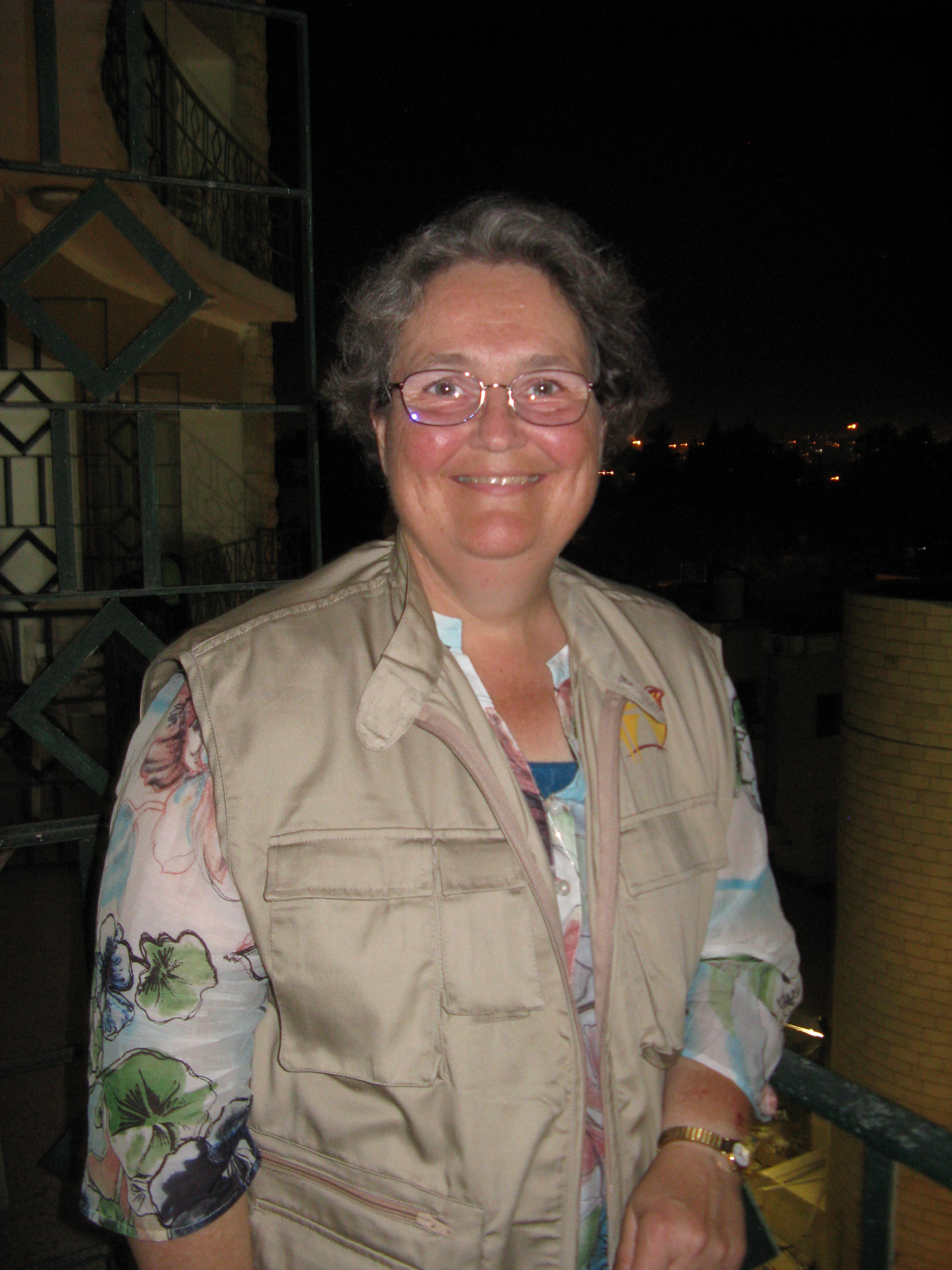
About snakes, scorpions, rocks and wolves

Dear Friends,

There are natural hazards here in the West Bank.  There’s the “deathstalker”, the pale yellow and green scorpion.  There’s the Palestinian Viper, who hisses and strikes quickly.  I’m told there are wolves.  And there’s the rock, everywhere the rock, easy to stumble upon, hard underfoot, under which the snake and scorpion can hide. This morning, in good humor, our driver presented us with a scorpion in a bottle. He had found it near our home.  We were duly impressed. Then he gave us a flint he found in the desert to take to our house. He hasn’t yet presented us with a wolf or a snake!

More insidious than these, however, are the human-made issues.  Yesterday we accompanied 12 school children home after school to Beit Yatir checkpoint.  Those of you have children may recall the anxiety the first day your children were old enough to go to school alone.  Maybe you waved as you put them on the bus or let them walk to school, trusting they would look both ways before crossing the street. How about if your young child had to go through a military checkpoint and go through x ray scanning on the way back from school, and then walk past a community guarded by civilians with high powered rifles and a reputation for harassment?  What if it were only safe for your children to go to school if internationals came to walk with them?
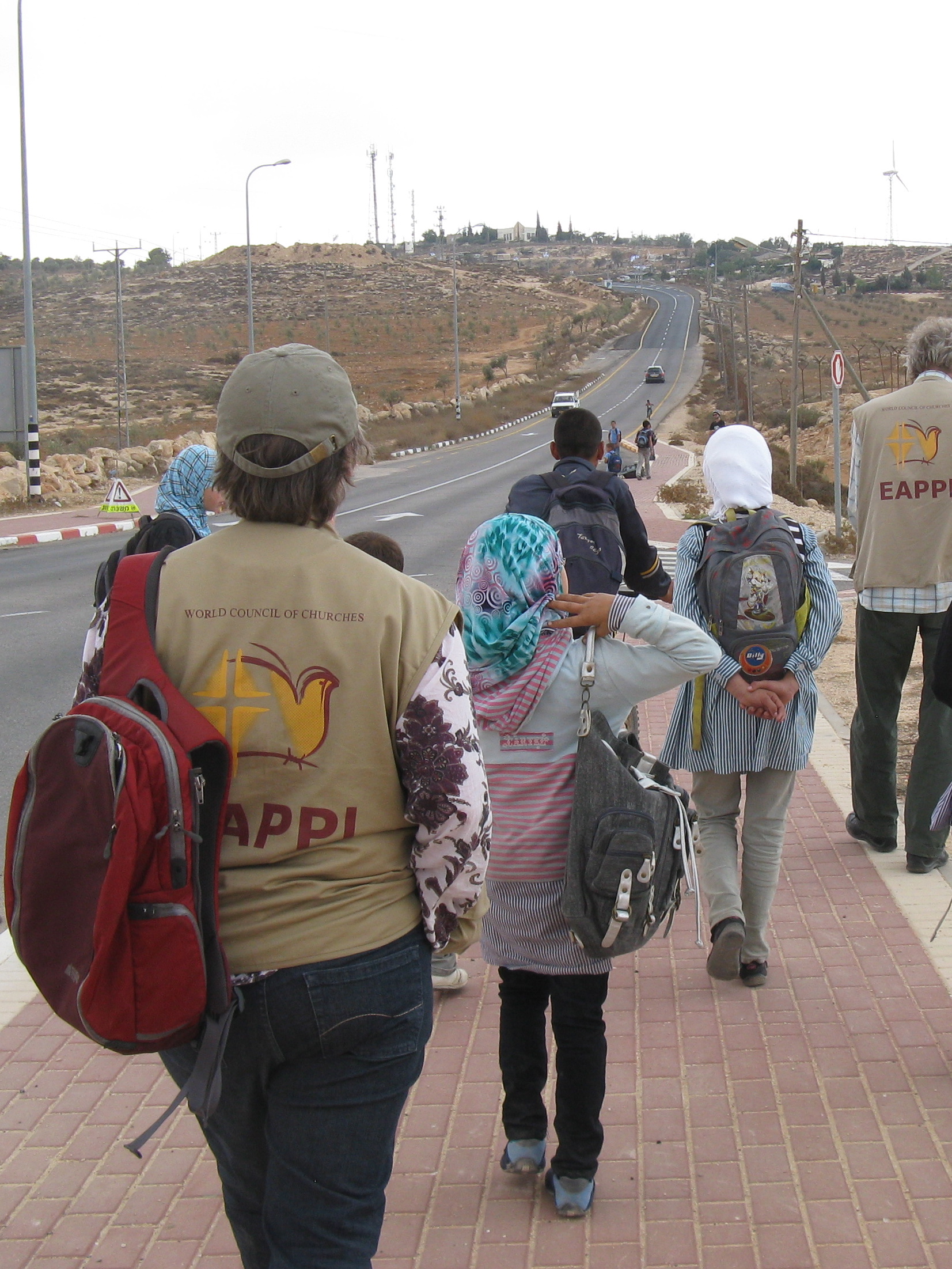
EAs Jan and Matti walking children home at the checkpoint.

For these children, daily irradiation and walking past soldiers with big guns is the price of a primary school education.  Sadly, because they are isolated in the Seam Zone between the Green Line and the checkpoint,  school time and the time they spend with international accompaniers is all the social interaction outside the home that they get.

In another community in Palestine, children from the village of Tuba must walk between an illegal Israeli settlement and its illegal outpost to go to the neighboring primary school in ATawani. This is roughly a 20 minute walk. In the past, they have experienced such threatening harassment that the Knesset has legislated a daily military escort for the children.  Even so, this escort sometimes does not come, or does not guard the children, leaving a large space between the military vehicle and the children, and settlers have threatened them despite the presence of the military.  Internationals are not permitted to walk with the children for fear that this would be seen as provocative by the illegal settlers.  So instead of walking with the children, internationals position themselves visibly on nearby hillsides to watch through binoculars as the children walk and to note the license plate of the military escort.  If the military escort does not come, these internationals then join the children and take them overland by a longer route, which is still not entirely safe and takes about 40 minutes. Before this international presence was set up, the children had to walk a very long overland route to school, a two hour walk one way.  Since the international escort, the number of children daring to go to school has increased from just a couple to around 15.  To learn more about this,  see the Christian Peacemaker Teams/Operation Dove report, “The Dangerous Road to Education”, available to download here:

http://www.cpt.org/cptnet/2011/01/04/tuwani-report-%E2%80%9C-dangerous-road-education-palestinian-students-suffer-under-settler/

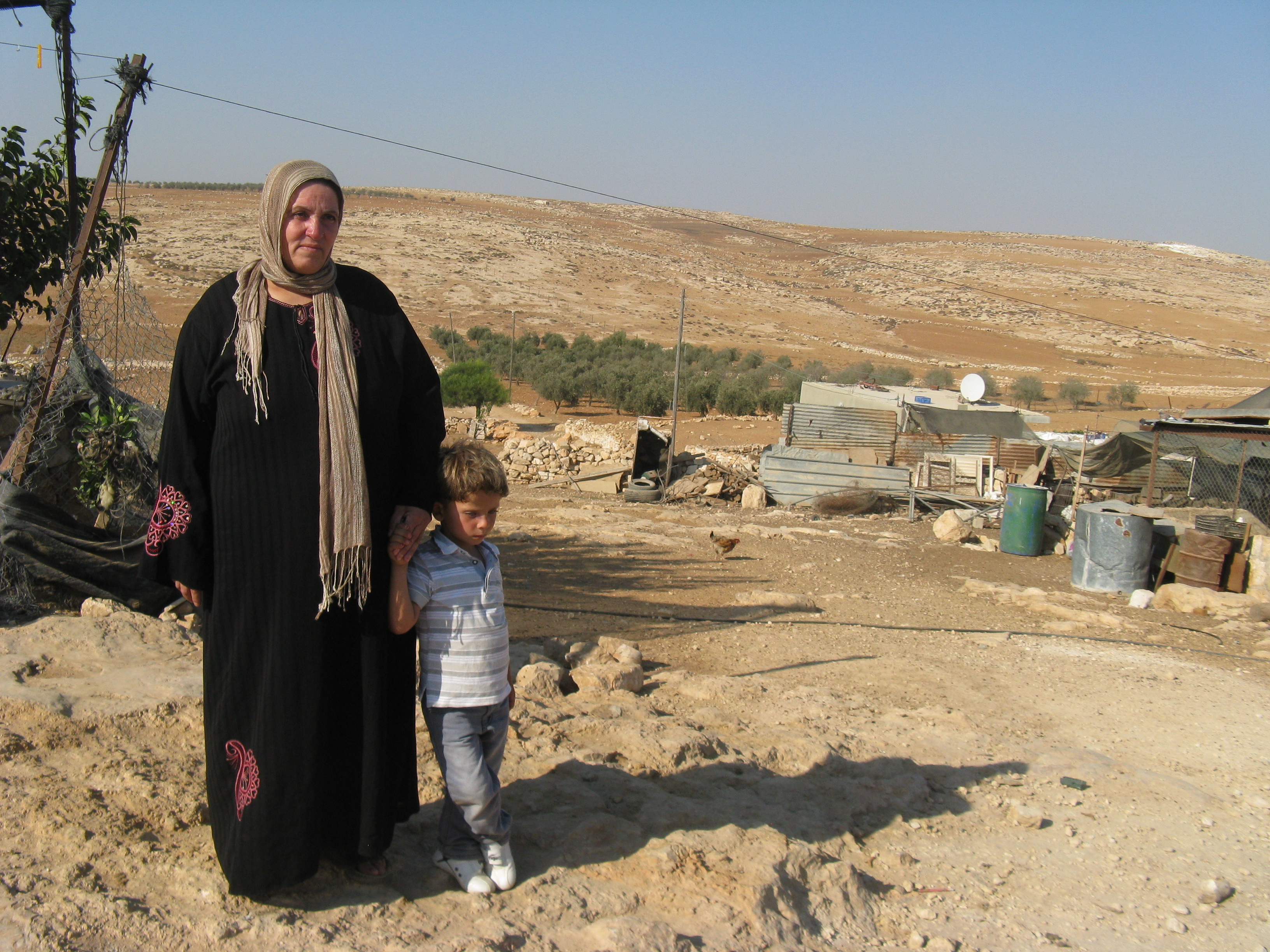
Today we visited the Bedouin village of Dkaika.  To get there we drove for an hour into a desert-like environment. The village has been in existence for many generations.  It consists of semi-permanent tents providing shelter for 350 people and their livestock: sheep, donkeys and a few camels.  The village has no electricity, and water is trucked in from 7 kilometers away and deposited in a cistern.  Lighting is provided by propane lamps.  There is a school for 60 children in this village, from grades 1 to 6.  After 6thgrade, they must walk a great distance in the desert if they wish to continue their schooling. The village is located in an area that is designated Area C and is under complete Israeli control.  It lies between two parts of Area C that Israel has designated as Military Zones. In order to understand this, it is necessary to know that all of Area C is within the West Bank and is Palestinian land inside the Green Line. The Israeli Civil Authority has demolished one classroom
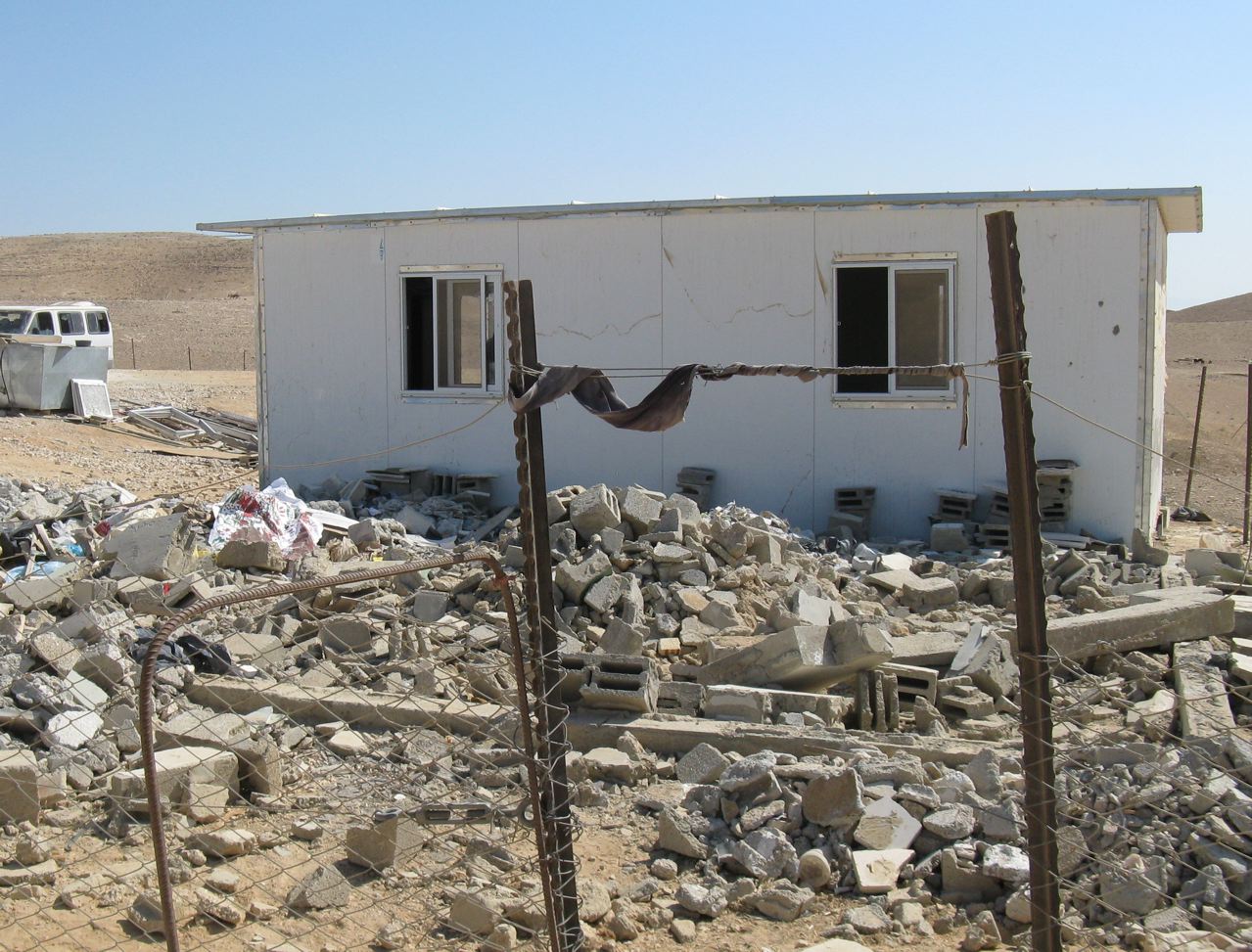
What remains of a demolished classroom in a school in Dkaika village

and severely damaged two more, which have been rehabilitated recently with the help of Unicef and Islamic Relief.  Unicef is helping the school to obtain solar power. Although the rehabilitated classrooms will be available for students to use in just a couple days, demolition orders against them remain in place.

The plan of the Israeli Civil Authority is to relocate the Bedouin population of Dkaika against their will, which is illegal in international law.  This plan to relocate people living in a traditional manner in small villages in Area C has been stated officially by the government as reported in Haaretz. See the following link:

http://www.haaretz.com/print-edition/news/israel-to-forcibly-evict-bedouins-from-west-bank-1.384290/

Regarding the fate of Dkaika, Rabbis for Human Rights has written,

“In the framework of our last appeal, the State made forcefully clear its intention to erase the village of Dqeiqa. Even if a plan is submitted, according to the State, there is a very slim chance that it will be approved. The declaration that the village residents will be transferred to nearby Bedouin sites was heard again. The village is recognized by the Palestinian Authority as an independent village. In the village there is a school, a mosque and a cemetery from the Ottoman period, but who are we to challenge the army, which has decided that Dqeiqa can not provide for it self as a social and geographical entity?”  To read more see this link:

http://rhr.org.il/eng/index.php/2011/09/demolition-orders-on-dqeiqa-village/

Under international law, an occupying power has a responsibility to care for the population and does not have the right to relocate the people against their will, nor to place its own population in the occupied territory.  The responsibility of care for children does not involve frightening them on the way to school, or demolishing classrooms.  Nor does it involve forcably uprooting them from their homes.  These are human rights violations, which must be seen by the world and hopefully corrected. Feel free to forward this note widely.
Watching history from Palestine

This evening Mahmoud Abbas gave his speech to the United Nations while, amazingly, we sat in the living room of a Palestinian family who had invited us to dinner.  We sat on cushions around a common plate of amazing maklouba and sipped tea.  As we observed them sitting glued to the TV screen, watching this speech with great pride and longing for their sovereignty, I couldn’t help but be struck with the immense hospitality of this people.  We introduce ourselves by name and nationality here, and eyebrows are always raised when I say I am from the USA.  It’s natural I should have to hear comments about President Obama’s refusal to support this UN bid. But what really strikes me is constantly repeated refrain, “You are welcome, you are welcome here.” Despite their natural bitter disappointment and anger at the US plan to veto their bid for statehood, they make a distinction between governments and individual people, and welcome to strangers is embedded in their nature.  Living in the desert as they do, they know the necessity of sharing life together.  And they deeply appreciate the solidarity that the World Council of Churches shows them in EAPPI.  It has been said to me, “I know you are part of the peace process.”

This people needs to be seen and heard.  They need their voice to be raised up and they long for the US to hear what they have to say.  After the speech, there was a long discussion.  Many comments from our friends here stand out.   I’ll just share one, from a young adult who essentially said, “They talk about 1948 and 1967.  What about yesterday? What about today? You have to know this.”  His frustration and pain were evident.  He means that the removal of Palestinians from their land is an issue now.  The people are living it now.  They are being harassed and pushed off their land now.

When we left Jerusalem this morning, it was swarming with Israeli soldiers preparing for demonstrations. As we watched demonstrators in Bethlehem and Jerusalem and in other Arab countries in support of the UN bid on TV, it was obvious that the will of the people here in the West Bank is strongly moved toward self-determination, a right guaranteed them by international law. Although there are other views about this bid, as Al Jazeera reports, particularly from the Palestinian diaspora whose concerns are related to the right of return, among other things, I couldn’t help but be moved by the mass of people asking the international community for support, and the fireworks here in Yatta right after the speech.  It’s a strange and humbling thing to be here just now and to watch the actions at the UN from this perspective.

Reasonable

This morning I’ve listened to President Obama’s speech before the United Nations.  I have to say the President is a very good orator.  I like to listen to him and I want to believe him and be on his side.  And what could be more reasonable than to say that there is no shortcut to a Palestinian state without negotiations?  But the historic fact is that the State of Israel was created without negotiations with the Palestinians, by a vote of the UN.

Nothing could be more reasonable than to say that Israel deserves to live side by side an independent Palestinian state.  But the facts on the ground, which Israel continues to create, set up a different reality.  Israel continues inexorably annexing more and more Palestinian land and dispassionately pushing the people off homelands and into impoverished little cantons while severing the geographic connections between them.  Palestinians fear that by the time negotiations work, there will be nothing left for them to base a viable state on.  It’s pretty hard to argue with the geographic realities; Israel is everywhere in the West Bank, herding Palestinians off the land into regional cities, controlling movement by both military and bureaucracy, using up the natural resources for their own benefit.

It’s true that the Jewish people are a people who have suffered much in history.  We visited Yad Vashem, the Holocaust Museum, with an Israeli tour guide today; it’s a tragic  and moving place. But it is offensive to play the Holocaust card as an excuse for Israel to abuse its neighbor. Reasonably speaking, negotiation in good faith can only take place between equals.  It’s pretty hard to negotiate when the other party’s foot is on one’s neck.

Visiting Yatta and three villages near the southern tip of West Bank.

Two days ago now, we walked around Yatta.  The locals speak about as much English as I do Arabic. And in Yatta itself, the people rarely see internationals.  So as the 5 of us walked through the streets to the souk (main street) we created a sort of parade.  It was the Muslim Sabbath and so there was no school.  Therefore, we collected about 20 kids walking and riding bikes, all of whom wanted to show off their three English phrases.  We gave away a lot of brochures about EAPPI to both children and adults and engaged a shop keeper in conversation about why we are here.

That afternoon, we went to three small villages near the southernmost tip of the West Bank.  In one village the people were deeply upset by the military’s placement,the night before, of an earth mound at the point where the village road meets the pavement.  The villagers expressed fears because, with the earth mound in place, they can not quickly leave the village if they need medical care.  Only their old truck might be able to cross the deep and imposing earth mound.  Already, however, the children have been going overland to school, taking a 6 kilometer walk (one way) each day.  This is because when they walk on the paved road, which is a much shorter route, they are harassed by the military because they are Palestinian. The overland route will be muddy and slippery when rains come in a couple months.

While we were visiting with the family, a convoy of eight military vehicles came north into the West Bank from Israel.  We wondered where they were headed. That is the nature of occupation; the occupying army can come into one’s land and do what they want.

In our next village, the military had erected an earth mound at the edge of their property also.  The villagers reported having tried to remove the earth mound, and one of them was arrested for this and held in detention for an hour for trying to remove it.  No reason was given for the erection of these closures.

In our third village, we found that one week ago the military had come and taken out the electrical poles and wires coming into their village.  The people have coped by running a generator at night for lights for two hours.  Cooking is largely by fire, but now there is no refrigeration and no way to charge or use electrical appliances, which greatly reduces the ability to communicate.

Little Ibrahim cannot walk on the road to go to school because he is Palestinian. This is not permitted by the military.

Ecumenical Accompaniers examine the remains of the electrical service to a village after the service was destroyed by the military.

The effect of these measures has been to intentionally isolate and add stress to the lives of the Palestinian people living in the far south of the West Bank.  It’s important to note that, in addition to the settler violence I have reported earlier, these policies of isolating the Palestinian people are being systematically put into place by the military.   These are simple people.  Their resistance to the occupation is simple: they insist on living on their land, which they own.  Every day that they stay in their own homes is a day of resistance.

Obstacles to peace in the South Hebron Hills

Dear friends,

Today I visited three villages in the extreme south of the West Bank, in Area C, which is an area under strict control of the Israeli military since the Oslo accords.  Numerous Israeli settlements have been constructed in Area C, taking up the area’s natural resources for their use and crowding out the local population by denying them access to their land. The settlements are illegal under international law.  The region is extremely dry as it is near the Negev desert, and water must be trucked to the people living there.

One of the villages, Mantiqat Shi’b al Butum, is a small tent village consisting of a few  extended families.   In this village, access to water has been made very precarious.  Most recently, on August 11th the Israeli military has moved a boulder into the road leading to the village, making passage of trucks into the village impossible.  The family we visited was very worried about the rock.  Previously, they removed it with a tractor, but the military put it back on august 26th and told them that if they moved it again they would build a wall to block this road.

A similar strategy of the military was used against the village of Wadi J’hesh, nearby.  Wadi J’hesh consists of only two extended families whose livelihood is shepherding.  Here the military has erected a mound of earth to completely block the dirt road leading to the village.  No vehicle can drive to the dwellings, which must be accessed by walking. No reason is given for these road closures, which have the effect of making life very difficult for the people. Not only water, but food and fodder for the animals must be brought in on these roads.  The strategy has the effect of making life on the land nearly impossible for the people.  But they persist because of their love for their land.

We also visited the village of Susiya.  Here, families who were previously cave dwellers were relocated to the area by the military. Now settlers in the nearby illegal settlement of Suseya regularly harass the family.  Recently, settlers torched one of the family’s tents during the night while people were sleeping inside it.  We were told that this occurred around 1 in the morning.  Fortunately, the smell of the smoke woke the people, who were able to escape and put out the fire.

EAPPI volunteers provide advocacy by sharing these stories globally in order to make people aware of the effects of the occupation, especially the harassment by settlers and the Israeli military against the people.  We also make regular visits to the village to protect them by international presence.  Please share these stories widely in hopes of helping these vulnerable people.

Arrived in Yatta

Arrived in Yatta today as daylight waned.  Our drive down was on public busses, a challenge with all our luggage, for sure.  I don’t travel lightly enough.  Yatta is a dusty city of one or two story dwellings, some with sheep pens on ground level.  We’re going up on the roof with our driver and translator in just a moment. We met with United Nations Organizing Committee for Humanitarian Affairs in Jerusalem this afternoon for a summary of the humanitarian impact of the occupation on Gaza and the West Bank citing trends over time, and then rushed for our luggage and the bus stops.  God is good, and we are here, frayed but none the worse for wear.  As tomorrow is an early day, this must be brief.  We will begin to go out to the villages and school accompaniments and so on first thing in the morning.  I’ve had a short Arabic lesson from Jawid, which I’ve quickly forgotten, sadly.  Maybe I will remember it tomorrow.  Inshallah.

Partners in Peace

On this day, in which I will begin my EA service in just a few hours, I sit in my hotel in Jerusalem and ponder all I have to be thankful for.  Many people have participated in sending me to this place.  For my family and close friends, who have let me go so far away for so long, thank you. I miss you!  For my religious order, TSSF, my contacts at Churches for Middle East Peace (CMEP) and Fellowship of Reconciliation (FOR), especially in Minnesota,  and my national coordinator in EAPPI-US, Thanks so much for everything.  For Lord of Life Lutheran Church and University Lutheran Student Center, Thanks so very much for all your love and support as I’ve anticipated this venture of service. Lord of Life: you sent me out so beautifully.  For your love, thank you so much!  For Luther seminary, students and faculty who have nurtured my learning and helped bring me to this place, thank you.  And for all of you who are following my blog, thank you for your care and concern for peace and justice in Palestine and Israel, for standing in solidarity with those who are suffering.  I head for Yatta tomorrow afternoon for placement orientation.  It will be overwhelming.  Keep the prayers coming, and I will make every effort to inform you as I go, so we will be partners in peace-making together with Jesus, who said, “Blessed are the peace makers, for they shall be called the children of God.”

“We are about to enter the land of freedom.”

Greetings from East Jerusalem!

We landed in Tel Aviv on 9/11 at just about 8:45 am Jerusalem time, and the flight attendants decided to commemorate the date with the following announcement:

“As we are about to enter the land of freedom, let’s pause for a moment and remember those who died for our freedom.”

I am remembering the attack on the Twin Towers and those who died, especially Father Mychal Judge, the Franciscan friar who died while caring for the New York firemen he served.  I want this world to be one of real freedom for all people.  I think we honor those who died in the horrific attacks of 9/11 by living up to the standard this country has held high, a standard that supports self-determination and human rights and freedoms for every child of our race, whether Christian or Jewish or Moslem or any other creed, dark-skinned or light-skinned, citizen or not, Israeli or Palestinian. We are only free when all are free. No one really has human rights all alone, although our Declaration of Independence describes a self-evident truth that God has endowed us with them.  They must be supported by community.

Freedom of speech. Freedom of self-determination. Freedom to pursue one’s happiness.  Freedom of association. Freedom of movement.  Freedom to protect oneself from evil, to live in safety.   How we take them for granted, these freedoms. How we miss them when we find them infringed.

Freedoms must be protected by the restraint of evil, but nothing is gained by considering whole peoples as evil.  Instead, when we do this, we lose hold of the thread that binds us, our common humanity.

“As we are about to enter the land of freedom…”   NO human society really measures up to such a claim, but we must strive mightily that it might be so. Indeed, I feel a prayer welling up inside me.  Dear God….Make it so, make it so at home and here. Make it so everywhere. Make it so that we do enter the land of freedom, really and truly, for each child of humanity.

Comings and Goings

I just got off a plane a couple hours ago.  And 6 days ago, I had just gotten off a plane.  And a month ago, I had just gotten off a plane.  And two months ago.  And so on.  In fact, my facebook account today shows me that a year ago today I was anticipating getting on a plane the next day. It’s getting so we barely ever put suitcases away here.

In a little under two weeks, it will be back into “the friendly skies” again, this time to DC and then off to Palestine and Israel as an Ecumenical Accompanier for the World Council of Churches.  I don’t know where I will be living for the three months of my service; that information comes closer to departure, and although I have my preferences, I’m willing for the Jerusalem office to send me where I am most likely to do some good.

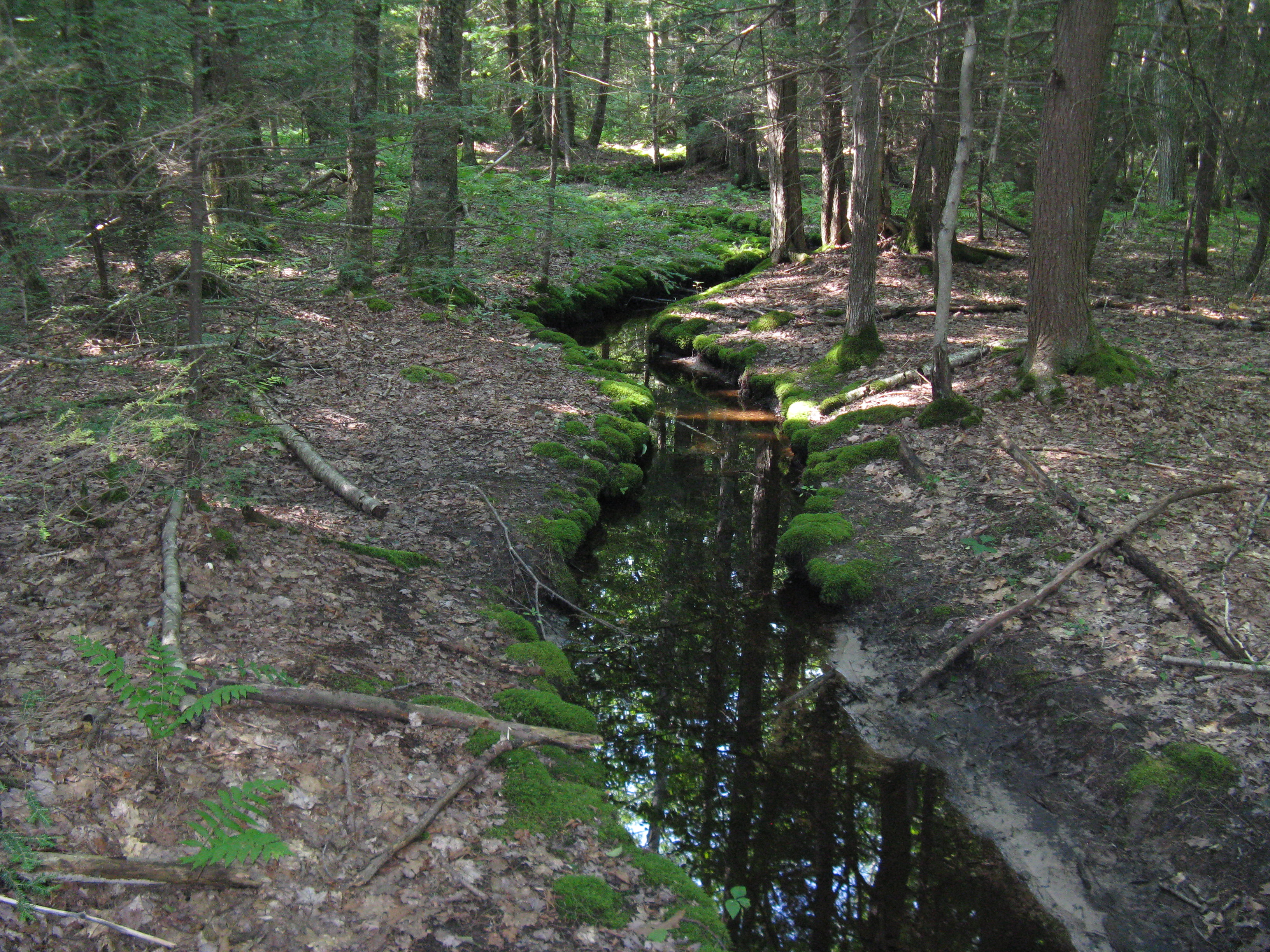
In the midst of all this, I was walking in a still wood in Maine this week, and this interior image is with me as a reminder of the quiet center of our lives where God continues to accompany us.  Francis of Assisi, who loved to pray in places like this, was a wanderer also, and reminds us to carry our hermitage with us wherever we go.

White Oak trail, Ferry Beach State Park, Maine

Humbled by the fellowship.


So this past weekend I went up to Circle Pines, Minnesota to attend a non-violence training event called Creating a Culture of PeaceCCP is an offshoot of the Fellowship of Reconciliation, an organization committed to finding peaceful ways for people to live together.

I found myself surrounded by great souls. One woman had been deeply involved in the Civil Rights movement.  A young American man had just come back from living in Iraq to have conversations with the Iraqi people suffering the aftermath of war in order to bring them back to the United States.  An older man talked about his healing from post traumatic stress syndrome after his service in war and how he had come to be involved in peace and justice ministry. Some people were seeking new direction in their lives and others were taking a breather between intense domestic and international encounters. A woman spoke of the need to work in a community where children were being bullied because of their faith.

The conference was interfaith as well as ecumenical. Baha’i and Moslem and Jewish and Christian (Catholic, Lutheran and others) and “deeply spiritual but not of a particular religion”, we came together to share and sing, talk and yes, pray together and share stories of working for better communication and reconciliation between people and populations.

We practiced active listening and responding peaceably in a “hassling” exercise.  We took on different roles in conflict scenarios to learn to see the points of view of others more deeply.

Significantly, we learned that peace with justice does not happen by chance, but that training and skills, personal centering and meditation, and communal strategies and plans go into making communities of peace.  For instance, we saw a video, A Force More Powerful, which described the use of non-violent resistance to evil.  Emphasized in this movie was the idea that non-violence is not passive but active and deliberate action, carefully planned in order to help bring about change using peaceful means. We examined the lunch counter sit-ins of the Civil Rights struggle in the American South as an example of a time when careful analysis and strategic planning along with personal commitments of individuals to be people of peace made a difference in desegregating social settings.

I’ve come away amazed and humbled by the example of many good people and knowing I have been witness to the work of God between and among people.  How powerfully God is at work in our world.