Always Christmas: Musings from days off in Bethlehem

Those of you who have seen the Narnia movies (or – anachronistically –read the books by C.S. Lewis) will remember that in the book, The Lion, the Witch and the Wardrobe, because of  the evil “White Witch”, in Narnia it was “always winter but never Christmas.”  Bethlehem is sort of the opposite.  It’s never winter, not in the white way people from Iowa and Maine think of winter.  But here it is always, always Christmas, one way or another.

Well, OK.  It’s Christmas every day, and even moreso in December and January, when three different branches of the Christian family celebrate Christmas on three different dates.

But yesterday I wandered into St Catherine’s, which is attached to the Church of the Nativity, and was able to join in a Christmas Celebration in English.  It began with “Joy to the World” and the readings were for Christmas day.  We sang Silent Night as we walked to Communion.  It was a very pleasant surprise, considering it’s October.

From my room at the Casa Nova guest house, I hear the church bells ring with great abandon several times a day.  I also hear the call to prayer 5 times a day from the Mosque of Omar in Manger Square.  Altogether, there is a feeling of easy peace between the Christians and the Moslems here.  The feeling pervades even the merchant sector. As one restaurant owner explained, he doesn’t take credit cards because if the people don’t have cash he just tells them to send him the money later.  They always do.  The diners are eating between the Mosque and the Nativity Church. God is watching. If they are going to rip someone off, he says, it won’t be here.

On the other hand, there is the real world.  Just up the road there is the Wall surrounding the city, where desperate men jockey for a good place in line, to get through the checkpoint at 3 in the morning to find work. Shopkeepers tell me that they own olive trees they can’t harvest because their land has been taken for Har Homa Settlement.  Or they can’t use their land because it was taken for Rachel’s Tomb.  Or that they would emigrate if only they could, to be free. All the issues remain.

But for today I choose to remember that here, somewhere in this little town, 2000 years ago, a baby was born who later would say, “Be of good cheer.  I have overcome the world.”  Such words will carry us through all the days of winter.

This Little Light of Mine….

Imneizil Village

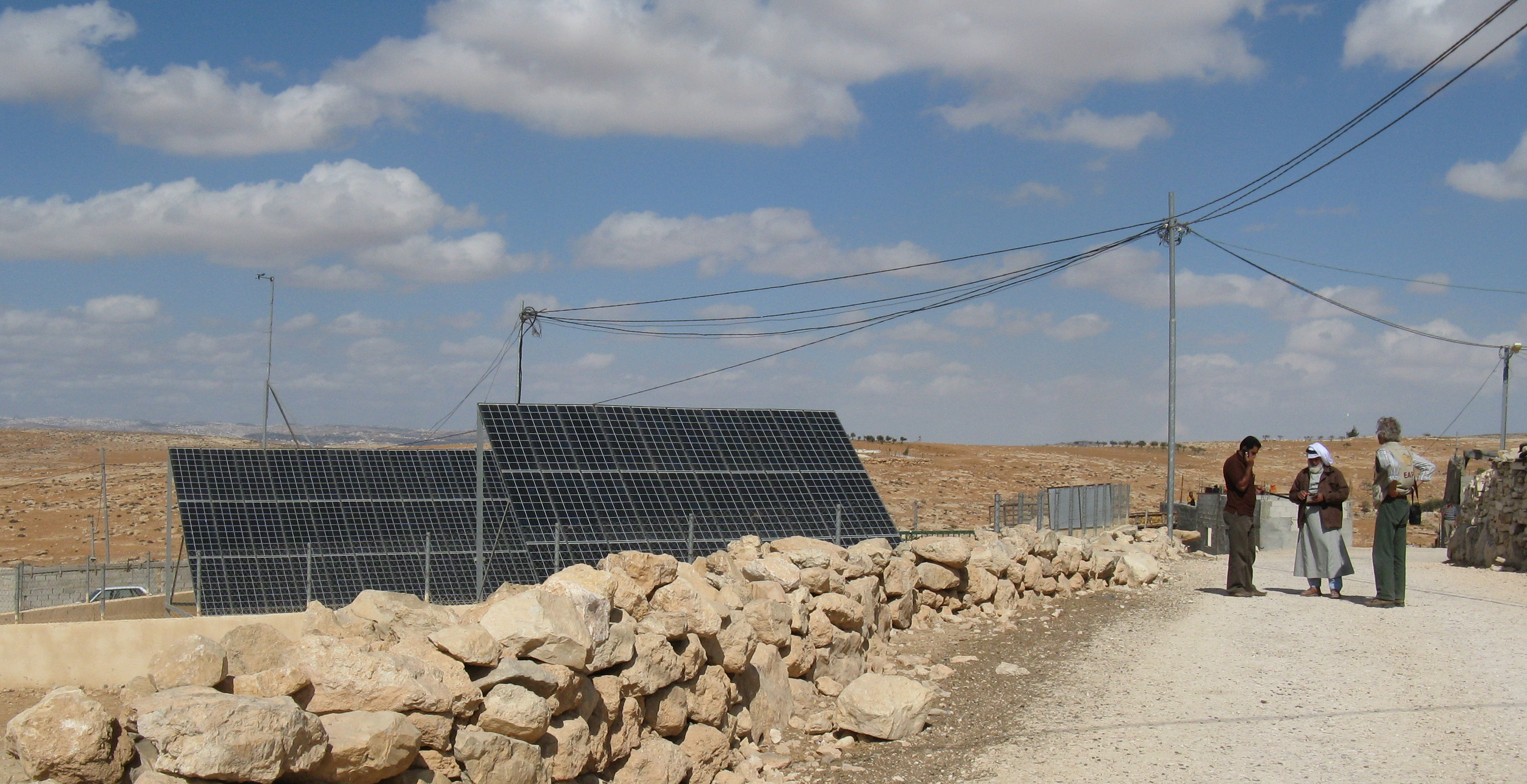
The Palestinian village of Imneizil, in Area C, sits just inside the Green Line and immediately beside the Beit Yatir checkpoint.  The village of 300 people, in 40 families, is impoverished, but in the last year the people received electric service when a Spanish initiative, Spanish Cooperation, provided them with an installation of solar panels.

These solar panels provide electric service to the village, to its health center, and to the Imneizil school, which serves 120 primary school students from the village and numerous tiny villages nearby.

Imneizil School itself has only two toilets (not restrooms but actual toilets) for girls and two toilets for boys, and has no potable water on site.  Therefore, the students bring their water from home. In the heat of the day this is not enough, and the students I accompany on their way home through the checkpoint into the Seam Zone have often asked me to share my water bottle.  The school is attempting to build a bathroom facility and a cistern to store potable water, but the Israeli Army came a week ago and commanded the school to halt this construction.

EA Matti discusses the demolition order against the solar panels.

Currently, the solar panels in the village of Imneizil are under a demolition order.  The order was to be enforced on the 18th of October, but the village has legal representation from Rabbis for Human Rights, which is fighting the demolition order.  Loss of the solar panels would have a severe effect upon the lives of the people of Im Neizil and would be detrimental to the education of the children in the school.  Obviously, this is a humanitarian issue.

It is legend that Abraham Lincoln, who went on to study Law and then became one of America’s most well-remembered presidents, began his education by studying in the candle-light. We think of these hardships as having built character: how amazing that Mr. Lincoln overcame the obstacles of his poor childhood.  But in the villages, when we pass the evenings in dim light and I hold a flashlight so the children and I can draw and color together, there is nothing romantic or edifying about low lighting.  Think for a moment about your children trying to do their homework without electricity and you will see what I mean.

Light, water, sanitation.  How do you manage a village without light? How do you run a school without water and sanitation?

Send us some energy to keep the lights on in Imneizil.

Since the demolition order against the solar panels needs to be appealed, today I want to bring that issue into the light.  Maybe you can send some energy!  Here are some suggestions.

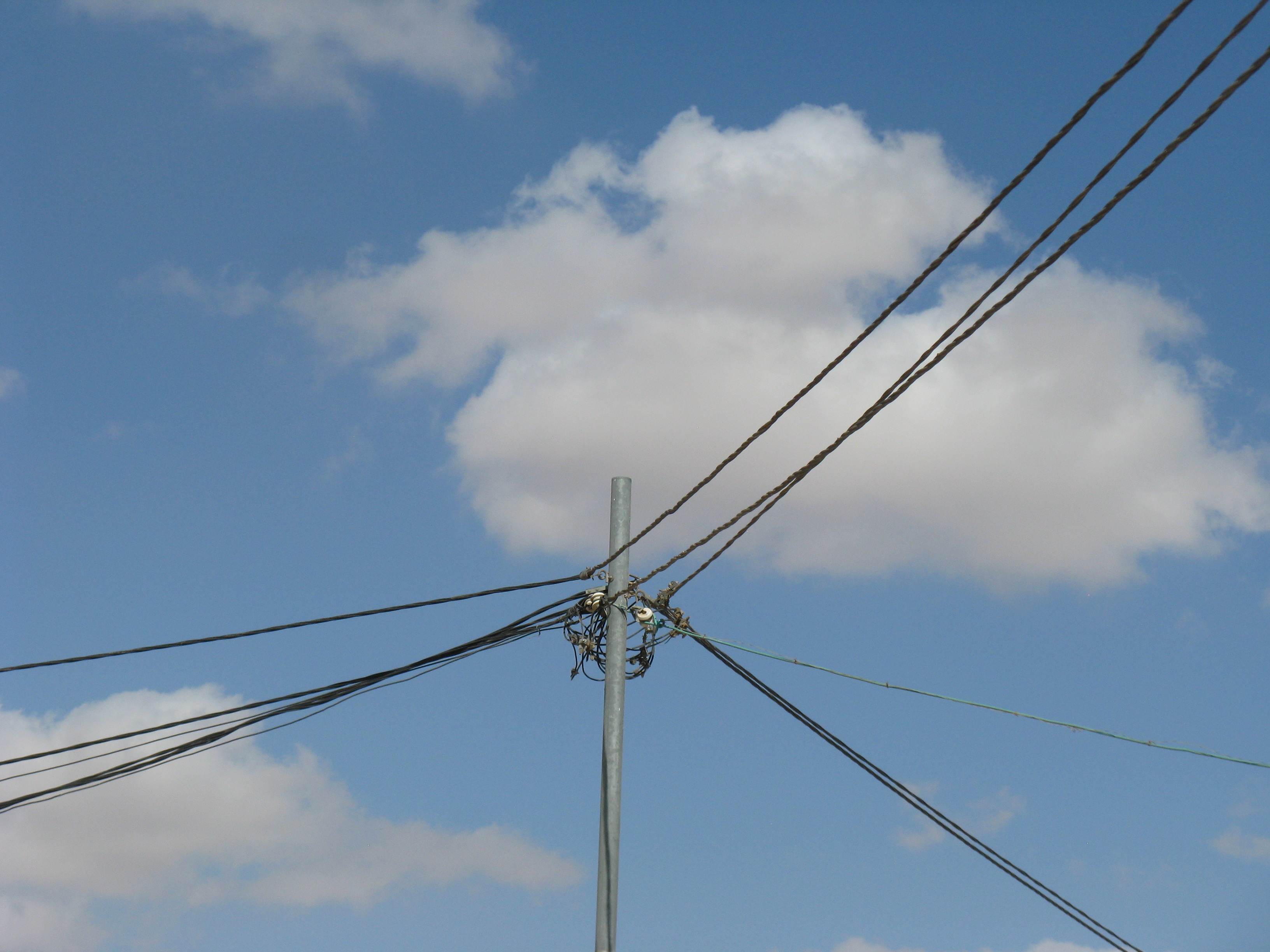
1. Write to Secretary of State Hilary Clinton (U.S. Department of State,2201 C Street NW, Washington, DC 20520) about this issue. Tell her you think the lights should stay on in Imneizil and that the people there and throughout the West Bank,  deserve to keep their electrical infrastructure.  (Perhaps you can also refer to the loss of electricity to the village of Khirbet Ghuwein al Fawqa last month, when the Army deliberately removed all the electrical poles bringing power to the village.)

2. Write to Israel (Government of Israel Ministry of Defense, Mission to the USA, 800 Second Avenue, New York, NY 10017, info@goimod.com) asking why the solar panels that give light to a small town and a primary school are under a demolition order. Remind Israeli officials that they have a responsibility under international law to care for the needs of Palestinians under occupation.  Ask how this action protects the rights of children to an education.  Let them know the world is watching.

3. If this bothers you, you can write your senators and representatives in Congress and tell them how you feel about turning the lights off in Imneizil and Khirbet Ghuwein al Fawqa.  The US gives a lot of money to Israel every year.  Is this how you want them to use your contribution?

Let your light shine.

When buying a ticket is not enough

In the first month of my EA service I’ve gotten to know Mohammed Nawaj’ah.   He is easy to like. A straightforward man, he says what he thinks. He has a sense of humor.  He dotes on his 30 grandchildren, of whom he is very proud, and he is unfailingly hospitable.

Today we visited him in his tent in Susiya.  Many of the family live in tents with some of his sons and many of his grandchildren, caring for the sheep.  His wife and other family members live in nearby Yatta; they go back and forth.  But Mohammed  himself chooses to live on the village land most of the time because he knows that it will be taken from him quickly by the Israelis if the family doesn’t maintain a constant presence in Susiya, despite court rulings that give him the right to live on his lands here.  Even with the villagers there, the community has suffered a number of incidents of heinous violence.  Two of its cisterns have been destroyed; in one case a crushed car was put inside, permanently fouling the water.  A tent was torched by night, causing terror and sending one man to the hospital.

The family didn’t always live where they do now.  Initially they were living on a different site nearby, in cave dwellings.  Mohammed and his wife began their family in the cave homes.  But 25 years ago, in 1986, Israelis forced them out of the caves and took over the site, which also contained ruins from the Roman, Hellenistic and Byzantine period, creating an archaeological park where the homes of Susiya had been. Since that time, the villagers have been uprooted and scattered on a number of occasions by actions of the Israeli government.

Last year, Mohammed and his adult son Nasser bought tickets to go into the archaeological park.  A film crew went with them as they watched a tourist video recalling ancient times in this place.  As I watched the film, I saw them touring the site and then looking  around the ruins.  They found their old home.  “It’s so cold here…” said Mohammed as he entered through the door of his old home and went down.  “There’s nothing left.”  When asked how he felt here, in this place where he and his family had lived, he said, “How do I feel? Hopeless, that’s all. When you leave your home, what is left?…I lost hope in everything, even in peace.”

As Mohammed came up from the cave site, the army came, three soldiers with an armored jeep.  They got out of the jeep and insisted that Mohammed leave the park.  Mohammed and Nassir protested. Why couldn’t they be here? They had bought tickets, like anyone else.  Nevertheless, the army drove them away.

The 15-minute film that was made that day was shown at a German short film festival, and Mohammed Nawa’ja and Nasser went to the showing.  The film is a work of art.  It tells in 15 poignant minutes the story of dispossession and loss which is the common bitter heritage of Palestinian people. It is not a fiction film that one can just walk away from and go on with one’s life.  It is a story happening to people I know. It is real.

“In Spirit and in Truth”

Responding to the religious infighting of his day, Jesus said that the day was coming when true worshipers would worship, not on a mountain in Samaria nor in Jerusalem, but “in Spirit and in Truth.”  Yet, do we really want that?  We want something tangible.  We want holy stones, like the Wailing Wall, or a holy well, like St. Bridget’s well or Jacob’s well. We want a holy historic place where holy blood was spilt, like Golgotha.  We want a holy grave where we can venerate the dead, like the tomb of St. Francis.  We want a holy isle where holy monks prayed, like Iona, as if the dust they brushed off their feet might somehow attach to the soles of ours and turn our souls to God.

I’m a Hajji, a woman who has made a pilgrimage.  In fact, I’ve made several: I’ve been to Iona, and to St Patrick’s Cathedral, and to the tomb of St. Francis and the Portiuncola and to St.Damiano Convento and to the Carceri, the great Franciscan sites.   I’ve been to the Vatican and the Colloseum.  I’ve been to the Wailing Wall, to the Tomb of the Holy Sepulchre (three times), and to the Nativity Church in Bethlehem. I’ve also been to Gethsemane, where Christ suffered anguish before He died, and to Dominus Flevit, the little chapel where we commemorate the tears he shed over Jerusalem.  I’ve waded in the Sea of Galilee and seen the Cathedral of the Annunciation in Nazareth.  I have way more prayer beads than I need, many of them purchased in just such a holy place as these, and my bookcases groan because of the weight of my theological library. I truly am a Hajji, through and through.

Why do I want these places, these things? Why do they have such a hold on us? Men and women are reported to have searched diligently for God in these places; we long for some kind of Divine touch there, at sites which we believe to be somehow permeable, somehow more open to the workings of the Holy than our mundane, flea-ridden and sometimes lonely every-day existence.  We imagine the holy people who sought God in these holy places to be somehow different from the lackluster, irritating or otherwise difficult everyday people we normally see.   Perhaps we think that going to pray in these places will curry some favor from God for us, or that we will be somehow changed if we pack our bags and traverse great distances in order to enter these places.

And it may be true that, when we arrive at them, because of our expectations, because of our faith, our prayer becomes deeper and we truly are changed.

Here in the West Bank I have seen something else.  Hebron is the second most holy place in Jewish life.  The place where Abraham and Sarah, Isaac and Rebecca, Jacob and Leah are buried in the cave of Machpelah  is now a mosque and a synagogue.  In the 1980s, a great massacre of Moslems occurred when an Israeli settler opened fire on them as they prayed in the mosque.  Now the site is heavily guarded, and one enters one side or the other only by permission of the Israeli military, by going through a checkpoint with metal detectors and xray machines.  The holy place of Machpelah has thus been profaned by violence. It is a place of anguish and uneasy truce,  governed not by prayer but by fear.

Machpelah should be a holy place but for me it was not.  Rather, at the Meitar checkpoint, that most secular of places where plain, ordinary men stand in line at 4 in the morning to go into Israel to work as day laborers, they kneel — these dusty, ordinary men carrying coffee and paper sacks of falafel, putting on their belts after the security inspection.  They kneel and bow their heads to the bare ground and humble themselves and pray to honor the name of God.  And so they hallow the checkpoint and I believe God meets them there, although most of them are too young or poor to have made the Hajj, the pilgrimage, at all.

A tale of two schools

There is a certain school. Let’s just call it a rural school.  Let’s just say it is somewhere. The learning happens in a large tent divided into classrooms. When you go into the classrooms, the students sing you a hearty welcome song.  They sing with energy and with happiness.  They have a teacher-student ratio of about 1 to 7, of which they are very proud.  Together with their hopefulness, this is their primary asset.

We reached this school by driving over dirt roads and past a partial roadblock consisting of a pile of earth and stones, which was being removed by hand by several men from the community.

In this little rural school there is no running water. There are no windows, and there is no electricity, so the classrooms are dark, but if the doors remain open, enough light enters for studying. Each class has a blackboard and a whiteboard.   There are no books except the students’ workbooks.  It goes without saying that there is no computer.  But there is a battery-operated boom box for language tapes.  The tapes can be borrowed from another school when they are needed.

The school was built because the students would otherwise to be away from their parents for a week at a time.  This would be hard, both for the sake of the students, who would be lonely, and for the sake of the families, for these are working children.  When they get up, they help milk the goats.  They help feed the sheep.  They care for the chickens and the geese and doves. They draw water from the cistern for their families.  They go out shepherding.

This means that when they come to school, they are hungry.  They have not had breakfast.  And so the World Food Program has given them chocolate milk and date bars.  They used to receive one date bar every day and one 5-ounce serving of milk.  But now, although they still have the milk each day, they only receive the date bars three days a week.  I guess that the economic crisis is being felt all over the world.

The teachers and the administrators have one room of their own, which must be both office and teacher’s lounge. It has three desks, three chairs, two filing cabinets, and a propane tank from which they can make a flame to heat water for coffee.

A few months ago the weather destroyed the tent.  So the administrators put it back up.  They wish they could have something sturdier, a building that would withstand the elements.    Of course, that would be a permanent structure, and therefore it would be subject to demolition by the government.

There is another school.  Let’s just call it an urban school. The children who study here must pass a number of checkpoints every day. They have their bookbags searched at gunpoint.  Because of their race, they are spat on, chased and teased on their way to school. They walk past hate graffiti that wishes them dead.  Other children throw rocks at them. Occasionally they have to run away from tear gas or bullets to go into their school. There are soldiers there, but they do not help them.

When I used to go to my children’s open house night, I never gave thanks for the road, the walls, the roof, for electricity and plumbing, for the school food program, and for government support for my children’s education.  As a parent, I took all this for granted.  I was wrong.

What hope looks like.

Picture, if you will, a construction site. It looks like any construction site anywhere.  Rebar lays on the ground. Fresh concrete has been poured.  Raw materials have been brought in and workers are on site.

It happens that this primary school of 120 students has only one restroom for each sex, consisting of two toilets each, that is, four toilets in all, for everyone. So it is a matter of some urgency to build an additional restroom, and that’s the plan.  But today we learned the Army has demanded a halt to the construction.

This school is in Area C in the West Bank. Virtually no building permits are given in Area C, so it is no surprise that there is no permit for these toilets.  But on the other hand, the toilets are urgently needed.  So they must be built.

The Army has told the head master and the workers that if construction continues, the raw materials will be removed from the site.  I’m a stranger here so maybe I don’t quite get it. Is it possible that school toilets are a major threat to the security of the State?

In situations like this, and there are many of them here, continuing to hold a vision for a better life and to act on that vision is what hope looks like.  Hope can be a pile of sand and a tenacious group of people who continue to plan for a better life.

Water

Hajji Haliim, a woman of advanced age, walks with her back slightly stooped, but as she arrived and greeted each of us, we felt her serene dignity. I felt a warmth in her presence as I listened to her story. Haliim has seen many changes. She remembers a time when the land grew wheat for bread and grass for the sheep. She remembers when the rains were good and, on the farm, “for the house we didn’t buy anything.”  The land provided everything that was needed.

In those days, her husband could ride a donkey from this place and the city of Beersheva to work, and then come home. But now, she says, Israel has the Green Line, which we can see from our seats in her tent in her little village of Khirbet Al Fawqa.  Now the Israelis close the road. Now the Palestinians have no work, and the young men just sit in the tent, since many cannot get permits to go to work at all. In these conditions, income is primarily generated from the sale of assets, primarily sheep.

Haliim remembers when she was a young woman in her early 20s.  She remembers when the land was under Jordanian control, how people lived together peacefully, without land theft.  She remembers a time in 1948 when the Haganah, the Jewish militias, came.  She remembers when Israelis killed a lot of Jordanians here.  She mentions this as a fact, without elaboration, and I want her to tell me more about those times, but what she really wants to say is about what is happening now.

Now the land is dry, dry. There is not enough food on the land, she says with evident concern, to fill the stomachs of the sheep.  There isn’t enough water for the people, either. It costs 100 shekels to buy 10 cubic meters of water to be brought in by truck.  “We don’t have 100 skekels per tank,” she says, and if you complain, you are told, “If you do not pay, let God give you water.”   God does provide, she says, but the people who have the water don’t give it. She knows that many international organizations are aware of the problems here, but in the village the people do not receive much.

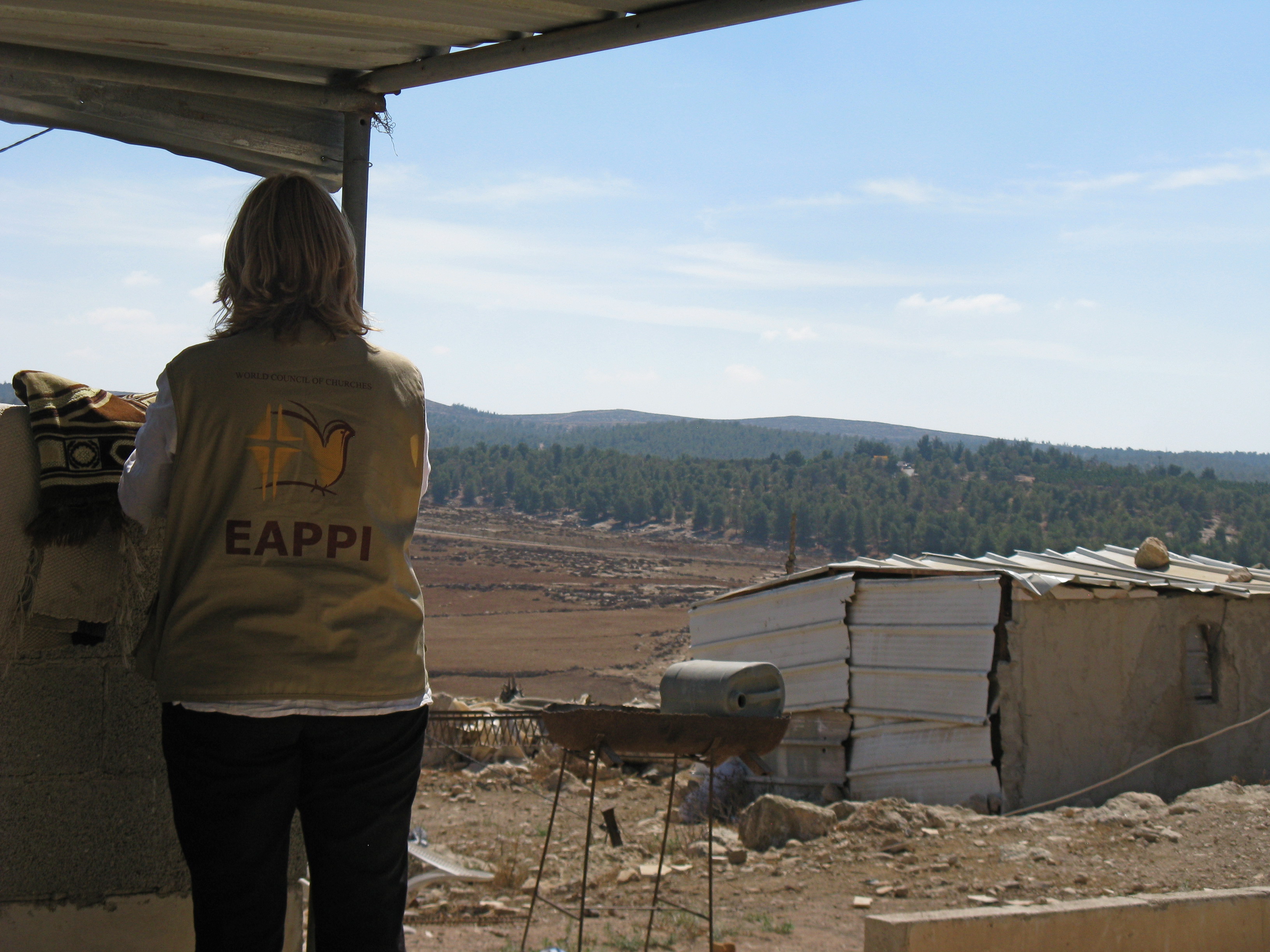
It’s easy to understand Hajji Haliim’s bitterness.  Usually one conceives of the Green Line as a line on a map, but on the ground there is no indication where it really is. Down the valley from the tent, we clearly see the Green Line because on the other side of it there is a forest.  It is actually green, a rare and refreshing sight in this land of drought and dust.  How can it be green so close to us?  On the other side of the Green Line, the Israeli side, there is the water. Looking at the contrast makes my heart very sad.
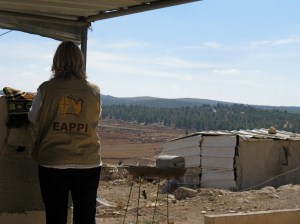
From the tent, EA Jasmine looks at the Green Line and the stark contrast in water access between the West Bank and Israel.

In the nearby village of Wadi Al Amayer, the concerns about water are also much on the minds of the people.  In this village, fodder for the animals is again a major concern.  The owner will ask for help from Oxfam.  Equally pressing is the need for more access to water.  There are no springs or wells here. The village has only one cistern to store water.

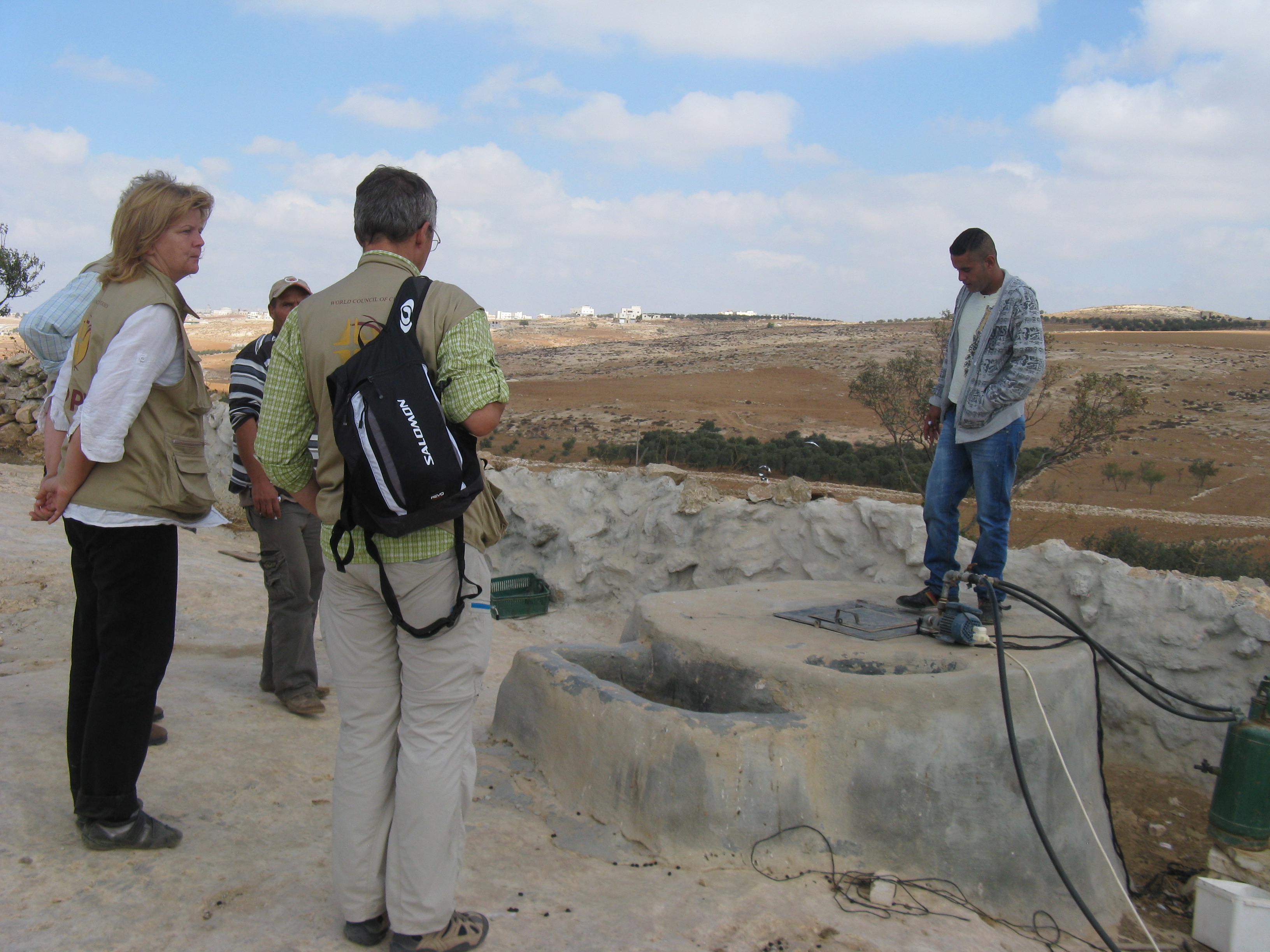
EAs look at the village cistern as locals share concerns about water insecurity.

It takes over two hours to go and bring water every two weeks by truck to refill the cistern.  But the people say the water the single cistern can hold is not enough for the six families and numerous animals that live here.

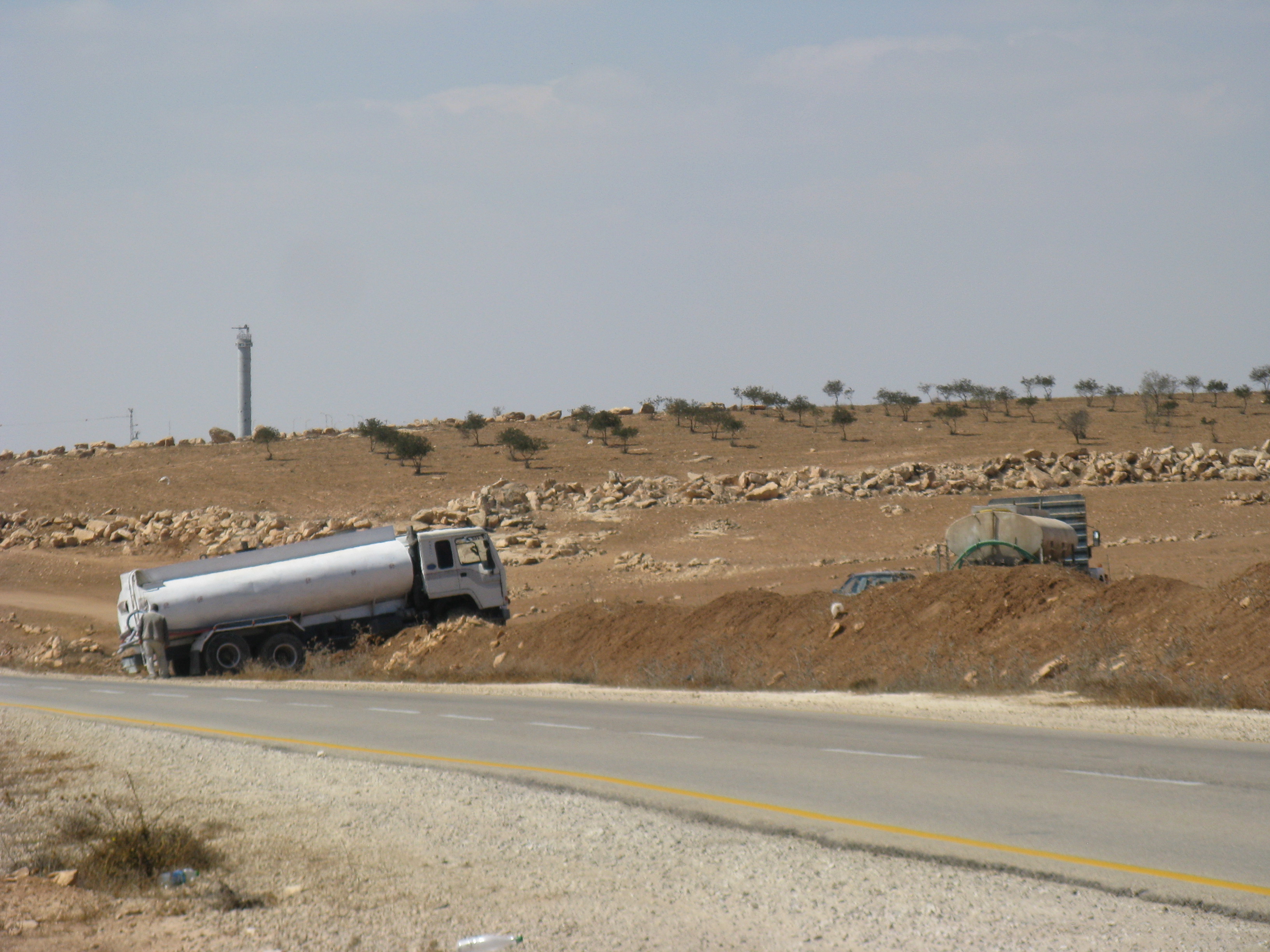
Trucking water into villages is made more complex by the many earth mounds and other road blocks that obstruct traffic.  These earth mounds are created by Army bulldozers, even though the land belongs to the West Bank, which is Palestinian.  This is the Occupation at work.  From our vantage point, we could actually watch the Army constructing such a barrier.  These barriers are regularly put up by the Army and then, just as regularly, they disappear and reappear, here or somewhere else.  The bulldozers seemingly never rest.  The result is that Palestinians, who rely on these poor, secondary dirt roads can never be certain which routes will be open.  We also observed a water truck today that was apparently stuck in an earth mound barrier.

The water truck is stuck in an earth mound placed by the Israeli Army in Area C.

As we entered one of the villages, we were stopped by the Army.  Three soldiers with rifles got out of their hummer and came over to see us.  They asked our driver for his permit.  After an inspection of the car, lasting about 10 minutes, we were allowed to proceed. I felt angry and tense about this unnecessary intimidation.

As we walked up to the village, our driver told us what had happened as the soldiers looked at his permit. “You don’t have a permit to drive in Israel,” they said.  “I don’t need a permit here,” our driver replied.  “This isn’t Israel, it’s Area C.”

The soldiers laughed.

A night in the village

A few nights ago, our team spent the night sleeping in the South Hebron Hills village of Susiya.  Susiya has been the victim of several vicious settler attacks, and EAs often spend the night there as a protective presence. Originally cave dwellers, the Palestinians in Susiya have been removed from their original location by the Israeli army, and their caves intentionally destroyed.  They now live in tents provided by the International Committee of the Red Crescent.

When we arrived, we were shown into a tent, inside which was an area the size of a generous living room with a small adjoining area for cooking.  The tent is set up on a concrete slab as a semi-permanent dwelling. The living area was lit by a single bare overhead lightbulb powered by solar panels, and had a carpet with several thin mattresses on the floor. Almost immediately, we were offered dinner.  There was the amazing bread, freshly baked in the taboun, an outdoor oven that uses sheep dung as the fuel.  There was a dish of diced potatoes with a little egg, to be scooped up with the bread.  There were sliced tomatoes as well as a tomato and onion sauce, for dipping.  And there were pickles.  This was the meal, together with sweet tea, of course.  We sat on the floor mats, and a large piece of plastic was spread on the carpet between us.  That is where the food was placed, and we all ate from the serving dishes by dipping the bread into them.

My teammake Bo took this picture of our evening meal. My teammates, Jan from Canada and Matti from Finland, are shown.

We are told that in this land, people often eat quietly, conversing after the meal over an extended time of tea, coffee, or both. After we ate, the extended family gathered with us in the tent and we exchanged what greetings we could with our limited Arabic.  Where are you from? How old are you? Do you have children? How old are they?  The enjoyment the family had with each other was obvious.  The numerous children were happy and were obviously loved by their many uncles and aunts and brothers and cousins. We looked at word pictures with the children, who proudly showed off their English vocabulary.

There was no television or video gaming in the village, but this was not missed.

Later, when the family that lived in this tent went to sleep, we were taken for a walk in the dark. We could see lights of the settlements and the army installation not far away.  The stars were lovely, and there was a soft baaing of sheep in the night. We were taken to another tent for us to sleep in. As we opened our sleeping bags the quiet of this place made it clear why the people love it here so much.  Our sleep was punctuated by the occasional flapping of the tent in the breeze, barking of a dog, honking of a gaggle of geese.

Despite the idyllic setting, I slept restlessly. When I heard the tent fabric rustle in the breeze, I wondered, “What was that?”  When the geese alarmed in the night, I wondered, “what was that?” When the dog barked, I wondered what the dog knew that I did not.  Were there intruders walking in the village?  I gained an appreciation of what occupation means for people who do not know what the footfall in the dark outside the tent might mean.

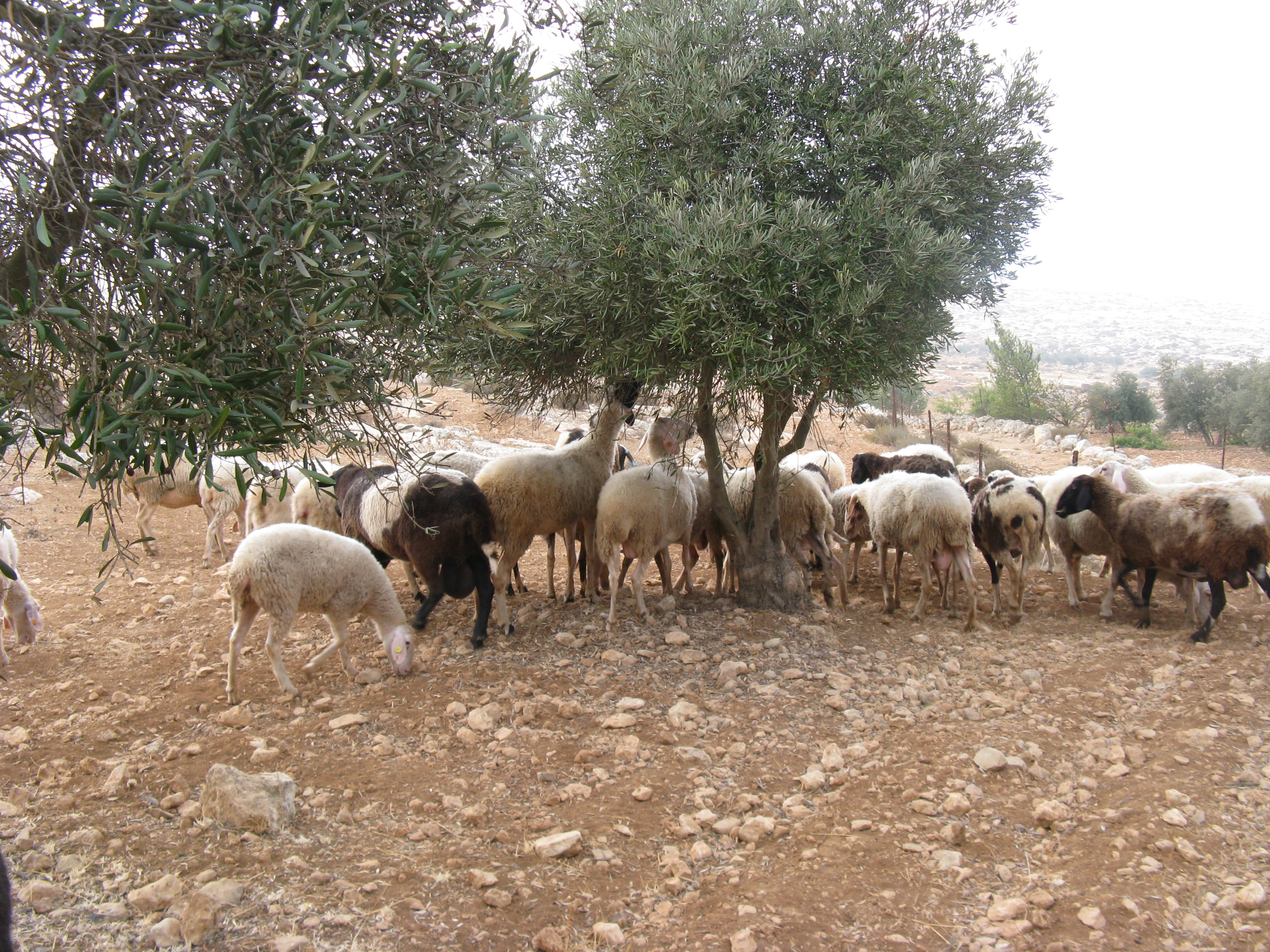
Thankfully, morning came without incident, and we emerged to see the sheep being fed in their sheepfold.  There is nothing for them to graze at this time because of the drought and because the rains have not yet come, but after they were fed some grains, the sheep were led out to graze anyway. The shepherd disciplined them for getting up on two legs to try to eat the leaves off the lower branches of the olive trees.

Sheep foraging in the olive trees in a time of drought.

We went out with the sheep for a while, gathering small sticks for fuel where we could find them. The boys showed us the herding dogs. Boys play with dogs in the same way here as at home, and we watched them having fun. Then we were invited to a breakfast of eggs, freshly baked taboun bread, olive oil and zaatar (a mix of spices: one dips the bread in the oil and then in the zaatar.), followed by sweet tea and conversation.

Village life is simple, except for the threat that overshadows it.

In the Wild, Wild West (Bank)…

Asalaam Aleichem, inshallah.  Peace be with you, as God wills.  Indeed, God wills peace for God’s people, it is true.  There is the inner peace that God gives. And there is the peace of the desert when all is calm; this is a deep, visceral, soul-stirring quiet.  May you come to know both these kinds of peace.

Everyday peace…now that’s another matter.  It seems that in Khirbet Arba, last week, maybe a stone was thrown at a car driven by a 24 year old Israeli man who had a young child with him.  In any case, he lost control of his vehicle and both were killed, and three stones were found in the car.  One of them seems to have come through the windshield and the other two may have entered the car during the accident.  At first it was hard to say, from the news report, exactly what happened. Now Haaretz has concluded, without complete forensic evidence as yet, that indeed, a stone seems to have been thrown.

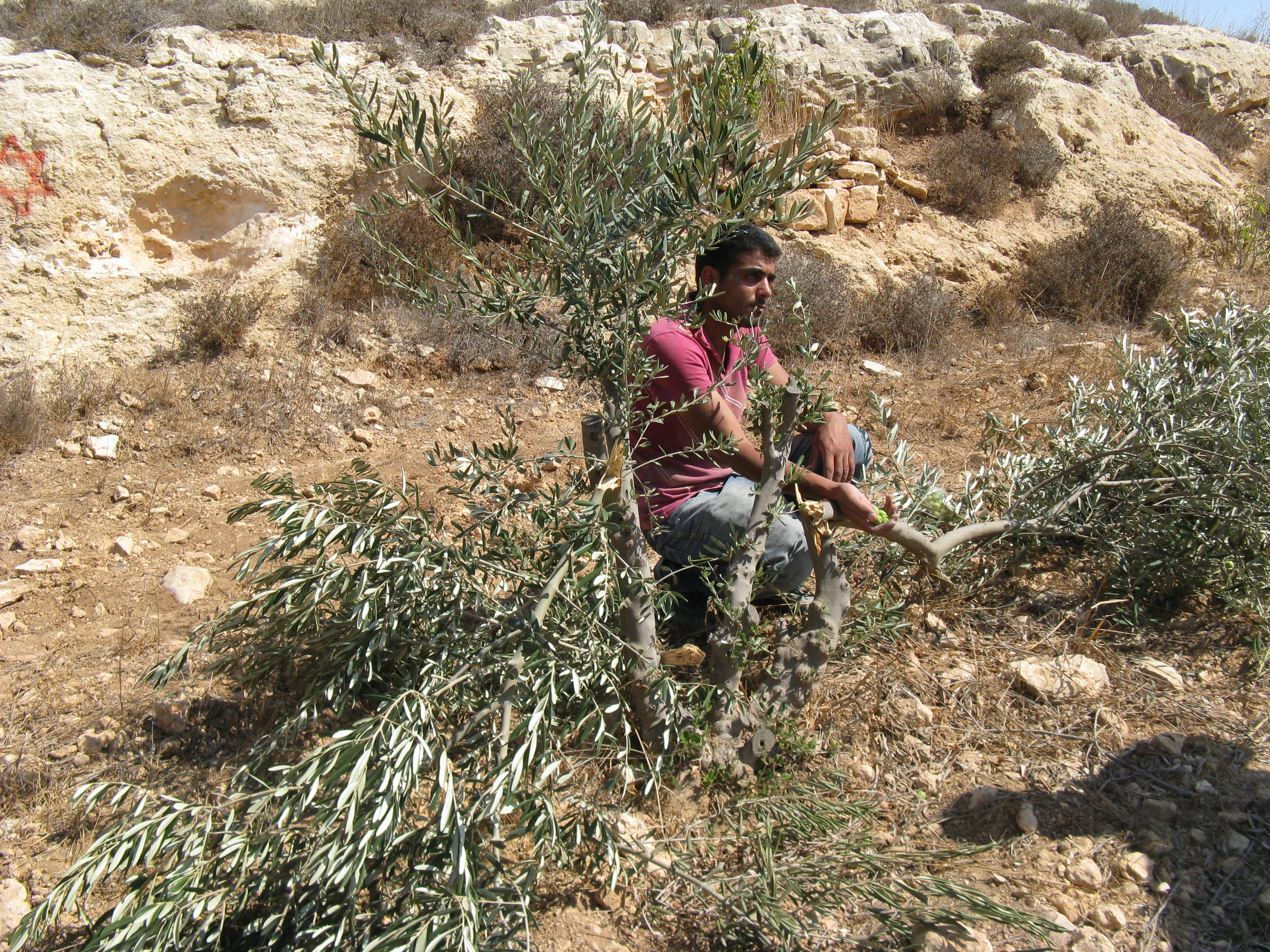
I wasn’t there.  So I don’t know any more than that. I certainly do know, however, that between the morning of September 28 and the morning of September 29, 46 olive trees were destroyed in the Palestinian village of Khirbet Shuweika.  I know because I saw them, a very sad sight indeed.

Farmer taking stock of the death of his trees.

I saw the owners looking forlorn and angry, because the olive tree, the shajara zatoun, is a friend that bears fruit for centuries.  These trees, about 12 years old, had their whole lives ahead of them, as did the man who died in the car crash and his son.

EAs, neighbors, UN and Btselem representatives came to examine the destroyed trees

In both cases, dear friends were lost. Both events are grievous, and essentially beyond our ability to take in. But what connects these two terrible events? In the orchard there was graffiti sprayed in red upon the rocks, and our translator of this event has told us that the writing says this is a “payback” for the event of the stone and the car.  Payback is a sort of lawless law, vigilante law.  It’s the law of the strong against the weak.  It’s the kind of muscle flexing that happens when fear is in charge.

From visiting the farmer who lost his trees, our EAPPI team was scheduled to drive to a checkpoint to escort children home from school.  We tried. But we were prevented. Unfortunately, the Army had roadblocked all the secondary roads so that it was impossible to arrive in time from our starting point.  In this case, it was the official actions of the government —  ever so many — that wrecked havoc upon the everyday lives of the people.

How badly this place needs peace and justice. The situation is bad for everyone. God help us poor human beings and rescue us from ourselves. God rescue us from institutionalized injustices that drive us to despair and violence.  God rescue us, the earth and all its creatures, from the violence we inflict.

Why don’t I have rights like them?

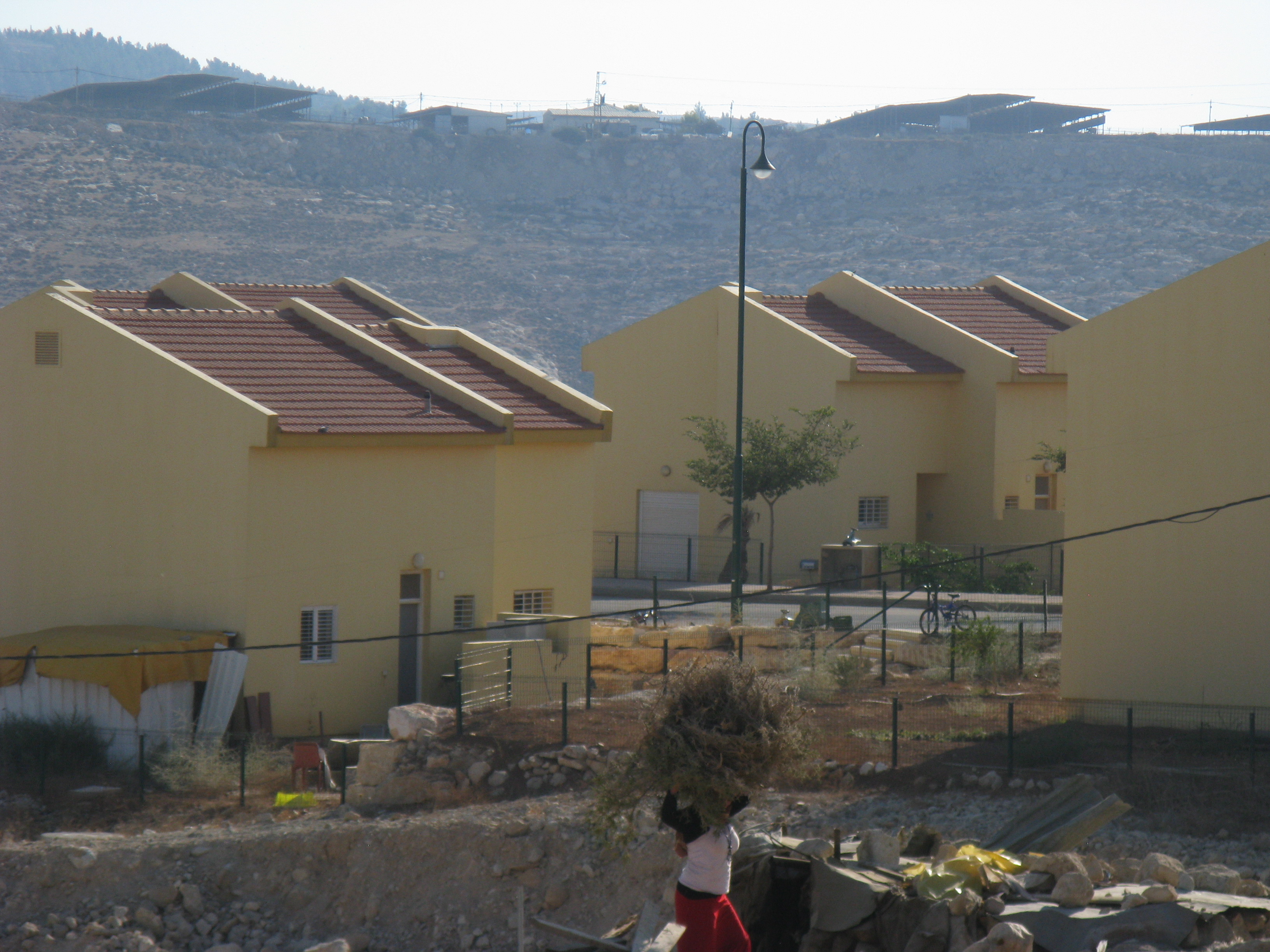
These houses in the Karmel settlement are built on Palestinian land inside the West Bank.

Right next door to the illegal Israeli settlement of Karmel, its neat yellow houses in perfect lines, its large industrial chicken farm looming on a nearby hill, is the Bedouin village of Um al Kher. The village consists of 21 families, a total of 127 people. People living here says that before 1948 they lived in Arad, but became refugees in that year during the Israeli war of independence (the Nakba, or Catastrophe, of the Palestinian people).  They purchased the land of Um al Kher and have lived on it since then.  They are shepherds living a very simple life on the land. Their water comes from a pipeline that runs through the illegal settlement, which began its existence in the 1980s.

Eid, at Um al Kher, with the settlement behind us.

One family reports that last week, just before President Abbas went to the UN, the settlement cut off their water supply and electricity. Family members reported that they were told this was a threat to show what would happen to the Palestinians if Abbas went to the UN for statehood.  The family has some solar panels and some water stored in the cistern. But the water they have will not be enough for the families there and the many goats as well. Nevertheless, they always make tea for visitors, sweet tea with mint.  It is the custom.

We were fortunate to speak to Iman, an articulate woman of 18 who will attend university soon. One of my team members offered her a drink of water from her water bottle, but she refused, saying, “I must be ready for no water, then if there isn’t water I won’t mind, like in Ramadan.” (Moslems keep a strict fast during daylight hours in the month of Ramadan, not drinking or eating  anything from sunrise to sunset.)  I found it heartbreaking to hear her comment, as if the religious observance of Ramadan could be compared to the lack of water due to someone else’s stealing it.  To think that the factory farm on the hillside contained chickens who got more water than these people was very disturbing to me.

When we asked Iman how she feels about the actions of the settlers,  she said she felt angry.  She went on to describe how, on the  Sabbath, the settlers come onto the village land and stand on it to pray and to stare at the residents of the village.  In addition, on many occasions, they have blocked  the road so she and other young people cannot go to school.

“The land means everything to me,” she said. “My grandfather and uncle are buried here….Why, why must they stop and check my car, why can’t I go on my own hill…. Why don’t I have rights, like them?”