Tech, faith, and our elders

Greetings.

For the next few weeks, seminary is moving onto the blogosphere.  I am engaged in a class that discusses media in terms of faith issues and faith issues in terms of media.  Part of our coursework is to create discussions in this space related to our readings for the course.

In that context, then, I am responding to a book by Professor Mary Hess entitled Engaging Technology in Theological Education. All That We Can’t Leave Behind. (New York: Bowman and Littlefield, 2005).  In this book, Dr. Hess treats the connection between faith and the digital world.  She makes the point that “digital technologies are cultures that we are embedded in, not just tools we use” (Hess, 90). Questions like “Who am I?”, “How do I connect with others?”, “How do I learn/how do I work/how do I play?”, and “What is reality like?” are questions we now ask in conjunction with our relationship to the World Wide Web.  A great deal of the book deals with what it means to be a person of faith embedded in digital cultures, that is, cultures in which more and more of what we do and how we define ourselves and our relationships is mediated through not just television and radio, but also Facebook, Twitter, the blogosphere, email, and the other elements of the global digital experience.

Of course this digital culture is the native land of the young.  It has also become the native habitat of the businesswoman, the academic, the artist, and the politician.  It has its own norms and language, still under development.  Learning the language is time-consuming and ongoing. The language relies on (expensive) hardware, (ever-morphing) software, and, more and more, by an ever-adapting neural net (think biology here) formed and shaped within the digital universe. There is an evolutionary change in societies of the West that is rapidly going viral and becoming nearly-universal in scope. We have connected to, and through, the microchip.  It’s science fiction, already here.  Everything is changed.  For instance, to be an artist who insists on getting dirty (paint, ink, mud) and making-things-by-hand in the world of graphic design is to be a bit old-school, these days, sort of like being a calligrapher instead of using a word processor.  In every field, the gulf widens.

Let’s segue now to the practical and the pastoral. Recently, I was in Washington for a conference and stayed with a local family for a few days afterwards. My host was anticipating the immanent demise of the phone book.  She had been advised that within just a few years, companies in her area would stop printing phone directories because “everyone has a smart phone now.”  Her solution to this household dilemma was to consider purchasing a small digital device to keep in the kitchen, by the phone, just in case she needed to look up a phone number.

There is something significant that has indeed already been left behind in this rush to universalize digital access and to facilitate this evolutionary change.  Not a what, but a Who, is being left behind.  The Who I refer to is a class of individuals: our elders.

Imagine, if you will, that at some point in your waning years the entire world as you know it begins to speak a new language.  It is a language, not of foreign words only, but of foreign concepts, as if everyone has become in some sense a member of a strange new race.  Everyone, that is, but you.

On my last trip home, my mother was complaining that I was always on my laptop, so I gave her a virtual tour. Imagine the conversation. “Look,” I showed her.  “This is where my photos are stored.”  (We used to hold paper photos in our hands. When can I get a paper photo?)  “This is where I can chat with my friends.” (We used to visit our neighbors, door to door.) “This is where I check the weather.” (We used to check the thermometer on the window.)  “This is where I can buy theater tickets.” (We used to visit while we stood in line.) “This is where I read my homework assignments.” (We used to read books.), “ and post my papers.” (We used to type, remember the old Underwood? … and we practiced penmanship.). “This is where I check my grades.” (We went to the mailbox).  “This is how I pay my tuition.”  (We wrote checks.) “How I access my medical record.” (What?)  “How I can make an appointment.” (I have to wait on hold forever on the phone.) “This is how I buy plane tickets and check in for my flight. It can send my boarding pass to my cell phone.” (Oh??)  “This is where I look up information.”  (We used the encyclopedia.) “This is how I look up maps, get directions, find out how long it takes to walk from one place to another in a city, zoom to street view to see what the neighborhood looks like there, and find out if there is an Italian restaurant nearby.  This is how I book a hotel room. How I get a map for the subway or the bus.” It went on and on.

The conversation was about community. “This is how I communicate with my friends, in Denver, in California, in Italy, in Switzerland, in Palestine, in South Africa, in Massachusetts, in Maine.” (She used to get paper letters with pretty stamps she could hold in her hand, and read over and over.)  This is how I found out a distant relative died.  This is where I first saw pictures of new babies in the family.  (We look at baby pictures for a while.) “This is where I talk to the world about things that are important to me, participate in discussions with others…” (Let’s sit in the living room and watch the nightly news together.)

These are not esoteric activities for the erudite.  They are not specialized tasks for the few.  These are the everyday points of access that make life human. The things that make for access to human community. I offered to get her a laptop.  Perhaps just for email and skype, so she could see people.  I could set it up, show her how. “No,” she said, “I am too old for that.”

By self-definition, she is.  But maybe she actually is.  I remember how it was for me.  I’m old enough to have found the transition difficult. (I hired a typist to type my master’s thesis on an electric typewriter.  That was high technology, before the word processor.)  I used to be very unwilling to enter the computer-scape.  My entry into it was painful.  I resisted.  I didn’t understand.  I felt like I was in a foreign land.  It brought me to tears on a number of occasions.  (Now what brings me to tears is when my computer crashes and I didn’t back up.)

We really do live inside our digital culture, but there are many outside this global table, sensing the change, unable to pay what it costs to join in.  At some point as we age, the idea of learning a whole new way of being in the world takes just a little too much time, money, and energy to contemplate.  It’s just a little too hard, too confusing.  “Checking a blog” might as well be “flying to Mars” for people who were socialized to reserve long-distance calls for the most dire situations. And so, all these human points of contact, along with the ability to do other commonplace things (like walking), become that much more distant and inaccessible.

What will our digitally enhanced community-building look like? For instance, a recent discussion on tornado-preparedness among Facebook friends considered whether siren warnings were really important when almost everyone has a smart phone now and can sign up for a weather alert.  While sirens as an emergency alert system have drawbacks, they convey a meaning across age, wealth and cultural divides.  This is a consideration that social planners need to have in mind. How can we include those who, for one reason or another, are not digitally connected?

Here is a question for our churches.  What is to be done for the elders when the phone books go away?  When they get to see only the photos that were printed? When safety alerts go digital?  We’ve begun to do a better job of getting computers into the hands of children in this country, whatever their income. But can we become aware enough to notice as our elders, and perhaps also those for whom English is an issue, the poor, and other disenfranchised groups, get eased out of the conversations of humanity and drop off the radar?  What ministry implications are there here?  How can we intentionally build community for the digitally deprived?

Exercising My Rights on the Hill

I’ve just returned from a few days in Washington, where I attended a conference entitled, “For the Peace of Jerusalem”, based upon Psalm 122 which states, “Pray for the peace of Jerusalem. May all who love her prosper” (Ps 122:6-9, paraphrased). The conference was put on by Churches for Middle East Peace (www.cmep.org).  This is a group of many churches in the United States in which the Evangelical Lutheran Church in America (ELCA), my denomination, is very active.  Our keynote address featured Melkite Catholic Archbishop Elias Chacour from Ibillin in Galilee, who has established a model high school for Israeli and Palestinian youth to attend together.  Archbishop Chacour is a refugee of the displacement of the Palestinian people in 1948, but despite being cruelly driven from his home along with his entire village at a young age, from the beginning he has led a life of peace and has worked hard to model and teach reconciliation.  You can read his story in the books, Blood Brothers and We Belong To The Land. We also heard about the Arab Spring and many other aspects of this complex and difficult situation, hearing from both Jewish and Palestinian speakers and gaining depth of perspective.

Tuesday was our day “on the Hill”.  Our conference culminated in a day in which we visited our Senators’ and Representative’s offices to share our concerns about the situation between Israel and Palestine. Sometimes circumstances collide in strange ways; it just happened that our day to make these visits was also the day  that Benjamin Netanyahu came to make a speech to a joint session of Congress.  The conference also just happened to be at the same time as the Jewish Lobby (AIPAC) conference and other conferences focused on peace in the Holy Land.

Mr. Netanyahu’s speech came in connection with his visit to President Obama.  Prior to Mr. Netanyahu’s arrival, President Obama had stated his opinion that peace between Israel and Palestine would need to be based upon the 1967 boundaries between Israel and Palestine, with some negotiated land swaps. Mr. Netanyahu responded that this would be untenable.  Although Mr. Netanyahu’s speech to Congress received many ovations, much of its content is disturbing. What was most distressing to me about Mr. Netanyahu’s speech were the statements that any two-state solution would leave Israeli settlements inside the West Bank, would require all of Jerusalem for Israel’s capital city, and would insist on continued military control of the Jordan Valley.  I fear this position does not leave a lot of room for our Palestinian friends to live in.  Mr. Netanyahu also emphasized that Jerusalem under the Israelis is open to all faiths, but in fact it is nearly impossible for most Palestinians in the West Bank, including pastors and priests, to even enter the city for worship, and more and more Palestinian neighborhoods are being demolished in Jerusalem.  Mr. Netanyahu also expressed unwillingness to negotiate with the newly reconciled Palestinian coalition of Fatah and Hamas.

The analysis that follows is from my observation and participation in the conference and the lobby day.  These are my own understandings and not an official statement of CMEP.  That being said, something we discussed  was the hope that members of Congress might wait and see what this newly-reconciled Palestinian government will mean.  One  benefit in this new development is that the Palestinian people are working toward speaking their truth with one voice.   How things will play out within this internal Palestinian dialogue remains to be seen. Support for the unity effort is explicitly not support for terrorism or violence, but it is the hope for the possibility of a dialogue that includes all parties in the conflict.

There is a resolution currently in the House  suggesting that US funding to the Palestinian government should be reexamined because of the unity initiative (H.Res. 268; I understand a similar bill may be emerging in the Senate). But the CMEP discussion included concern that withdrawal of financial support from the Palestinian Authority now would likely be detrimental to the peace process. In my own opinion, the financial support the United States gives Palestine is very small indeed compared to the massive amount we provide to Israel.  There is no equity here. Palestinian aid is carefully controlled and directed, and supports development of that government and its security forces as well as providing funding for UNRWA  (the United Nations Relief Works Agency, which offers education, nutrition and other support in Palestine).  Having toured some of the refugee camps where many of the poorest Palestinian children attend crowded UNRWA schools, I know that these schools are operating with less funding than they need.  Withdrawal of support for the PA now would be a blow to the hopes and dreams of the Palestinian people and cause them increased hardship in education and in many other areas of daily life.

Our Iowa delegation went to see staffers at the offices of Representative Tom Latham and Senators Chuck Grassley and Tom Harkin.  We felt that our comments were given a careful hearing.  In the case of the senators, the staffers took notes on our meeting to share with the senators.    It was great to learn more about how to participate in the process of entering into these kinds of conversations.  This is only my third time lobbying, and CMEP provided excellent guidance and support.

In addition, I felt proud to demonstrate and pray with a group of Episcopalians led by Bishop John Chane, praying and demonstrating on a street corner by the Capitol on behalf of Bishop Dawani, the Anglican bishop of Jerusalem, who has had his Jerusalem residency permit and visa revoked. This is just one example of the many ways in which the current political situation creates hardship for the Palestinian people, by limiting their ability to move freely, to work, and to live in Jerusalem.The Episcopal group was one of many groups demonstrating in the Capital, some praying quietly and holding signs, some chanting, some using microphones to address the crowds.  The day was interactive and lively.

All in all, my time in Washington was an opportunity to participate in some of the most cherished freedoms in the world including the right to free speech and open discussion about how our government ought to act in the world, and the right of the people to peaceably assemble and petition for a redress of grievances.  It is for these sorts of rights that people in the Arab world have been demonstrating.  At the end of the day, as I returned to a friend’s for a meal and a good night’s sleep, I reflected on how much rests upon whether we make good use of these gifts of freedom, entrusted to us in order for us to be active in the cause of justice and peace. The end of Psalm 122 says that we seek Jerusalem’s peace for the sake of our friends and kin. We are all connected. In my opinion, no one experiences full human dignity, safety, self-determination,  and freedom, until everyone does.

Peace and Good,

Chris

With gratitude

Well, I taught my last class here.  At least, for this trip.  I keep hearing, “Are you coming back?”  Inshallah, is all I can say.  Yes, I want to come back, as God wills.  It’s a matter for prayer.

tree growing through a concrete wall at Aida Camp

tree growing through a concrete wall at Aida Camp

My apartment is rapidly getting less cluttered as more and more mementos are stored for transport.  I’m really tired.  Bethlehem is a city of hills and I am accustomed to a flat place.  There have been a lot of challenges here, mentally, physically, spiritually, but I have received countless blessings and I am full of amazement and gratitude to God for the gift of this trip.

Many of the students have made rapid progress.  It’s been exciting to watch them.  It’s a longer road for some than for others, but almost everyone is making a great effort.

Now it’s time for me to make a great effort and drag my sorry backside halfway around the world.  And after that, it’s integration time: papers to write, sermons to offer, talks to give, and the mighty work of seeking God’s will for the future. For 2 years I’ve worked for this event.  What is on the other side, I have had no glimpse of. As usual, God keeps the blueprints to Godself.

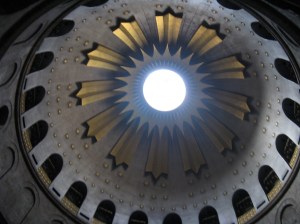
“I woke up in the middle of the night to see soldiers around my bed,” a friend says to me. “Go to sleep,” they told her.  Then they took one of her family members away.  A student near here was taken away this week and deported to Gaza, a student who needs only 2 months to complete her bachelor’s degree, but now it will be difficult for her to graduate. We heard fighter jets and explosions near here last week. Children hear of Gaza and suffer pain; they have relatives there.  It is only an hour’s drive from here. Yes, there is pain here, deep and abiding memory of injustice past and present. Yet I have seen love here.  Humor here. Forgiveness here.  Belief that life is worth living abundantly.  There are prayers for peace here still. There is hope here in the midst of the sadness and anxiety and hopelessness of occupation. Let’s nurture it. My last image for this blog from Palestine: the dome of the Church of the Holy Sepulcher.  Let the light stream in.

God bless and see u on the other side,

Chris

Dome above the tomb of Christ

Dome above the tomb of Christ

Home Sweet Home in Beit Sahour and the Sunday that followed.

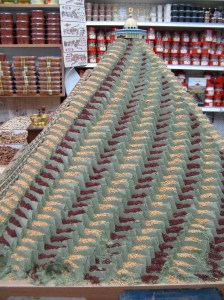
mountain of zaatar at spice vendor in bazaar

mountain of zaatar at spice vendor in bazaar

Greetings friends.  Yesterday afternoon the students and I spent the afternoon painting in Beit Sahour, the town outside Bethlehem where the shepherds are believed to have seen the angels.  There is an olive orchard there, below Bethlehem, where we enjoyed the warm weather and worked on paintings.  When we were finished, one of the students, who is a fashion designer, invited us to her home where she made me a drink in the blender from a lemon she picked from her tree, with mint, absolutely exquisite after time in the sun. I saw the gorgeous dresses she has created using modern lines and Palestinian embroidery. Afterwards, a friend invited me to dine with her family in Beit Sahour.

Family relationships are very important in the lives of the Palestinian people.  My friend and her husband and two children live in a building which they own together  with extended family, and many other family members live on their street. Their small balcony looks east toward the Judean wilderness.  Just below their home their yard slopes toward the settlement road between two Israeli settlements.  Much land has been lost to the Palestinians because of these sorts of roads, which are walled or fenced off in both directions.  Beit Sahour has lost much land because of this road.  The family home has two small bedrooms and a living and dining room combination with a small, efficient kitchen.  It is simple and lovely.  My friend is a gourmet cook.  We had ice cold beer (note to friends, yes, I drank a beer, Carlsberg from Denmark, my first beer since 1976, and I liked it, to my own shock.) Dinner was amazing and I took notes on the preparation of some of the foods.  Most memorable was a layered dish of penne pasta with a sauce of yogurt, ground lamb, mint, and fried slivered almonds. The boys proudly showed me their memorable artwork which reflected  their reactions to the seige of Gaza.  (Dar Annadwa has had a show of the drawings of over 500 children related to this theme.)  They also shared their photo albums detailing their lives from birth until now.  One “reads” the photo albums from left to right, of course, as one would read Arabic or Hebrew.  The boys taught me this.  They have very good English, speaking and reading, and I enjoyed talking with them.

A few years ago, Beit Sahour resisted the occupation with a tax boycott of Israel, and they suffered 4 months of Israeli military engagement. My friend tells me that when the boys were young, sometimes bullets would fly through their window.  The family has been afraid at times because of this sort of violence.  They also told stories about the impossibility of obtaining proper health care in the Bethlehem region.  Hospitals refuse to see patients because it is Sunday, for example, and doctors refuse to see patients without first requiring the patient to pay large fees which they do not owe.  Even serious injuries go untreated.  One needs a permit to go to Jerusalem to obtain services at a proper hospital; obtaining the permit may take anywhere from a day to a week or perhaps will not be granted at all.

After dinner, my friend showed me some of her own art and craft work and then we settled down to a bit of “al tilivision”.  Incongruously, we sat and laughed together at the movie, “Meet the Parents II”.  How strange to run into it here in the home of the shepherds of old times.  All in all it was a wonderful evening, filled with welcome, great food, hospitality and humor.

I was happy to return to the flat as it had been a very full day.  Late that night, though, I lost my electricity; there was a great “pop” and an arc of electricity rushed quickly through the living room.  By some miracle, I did not have my computer or my travel phone plugged in at the time; I had been too tired to set them up to charge during the night. So today I threw out the dairy products in the fridge and the landlord came in and reset the circuit breaker.  I think bad wiring in the ceiling light is the cause.  The lightbulb has burned out, and I will mention it when I leave; I don’t want to use that circuit again while I am here. But the good news in the flat is that it was a hot day, so this evening I have plenteous hot water, which heats up in the tank on the roof in hot weather.

The day was spent in pilgrimage to St. Catherine’s for mass.  The church was full and the worship of the congregation was full of devotion. I can follow the service even though it’s in Arabic because I grew up Catholic and the service is more or less the same throughout the world.  There is a large crucifix set up about halfway through the nave.  Before mass, people would reach up to touch the feet of Christ and then make the sign of the cross.  This crucifix is much like the larger one which is on display in the shrine at Golgotha, inside the Holy Sepulcher church in Jerusalem.  These Christians cannot go to Jerusalem even tho they live 5 miles away because they don’t have permits.  But they can venerate this cross instead.

Afterwards, I had a nice afternoon. This began with a leisurely lunch at Casa Nova Pilgrim Palace Coffee Shop, complete with a cat fight going on inside the restaurant.  The occasion of a wild cat begging at my table, eventually chased off by a larger wild cat in a turf battle, created an opportunity for conversation with people at a neighboring table and I eventually joined them: a priest from Jerusalem and his friend.  After that I spent time in visiting some merchants; it’s somewhat unavoidable since one must walk through the bazaar to get from my house to anywhere.  In one shop was a mosaic artist whose work I had seen at Dar Annadwa and he spoke with me about his craft.

Dinner tonight has consisted of fresh milk, flatbread, and fresh figs.  I’ve heard it said that from the nourishment of 5 figs a grown man can walk all day.  Or was it dates?

Thanks for reading. I miss u all.  And cold cereal.  And showers.  Blessings,

chris

beverage vendor carrying his wares into bazaar to sell to shopkeepers

beverage vendor carrying his wares into bazaar to sell to shopkeepers

Just passing through.

Hello Y’all.  I’m home in the flat in Bethlehem.  Arnie’s Sabeel Witness Visit ended today and he had invited me to join him for coffee in Jerusalem before he headed for the airport, so I grabbed the essentials and headed through the checkpoint one more time.  Today is Friday, the Islamic holy day of the week.  The checkpoint was full of women in beautiful hijabs and older Arabic men on their way to worship at Al Aqsa Mosque. (Younger men are not permitted to go to pray at the mosque.)  It was very busy and I found myself to be nearly the only international in the line of about 500 Arabic-speaking people waiting their turn to go through the turnstyle. I was able to strike up some very tentative conversations with the women, who know about as much English as I know Arabic, which is, believe me, not much.  For instance, one woman was fingering her “99 Beautiful Names of Allah” beads so I took out my Orthodox prayer beads on which one can pray the Holy Name of Jesus (Issah, in Arabic, and then you say “Peace be upon Him”). I explained the use of these beads, but one man in the crowd, seeing them, assumed they were remembrances of my many children (there are 33 beads.) When I laughed, I ws told that some Arabic women do, in fact, have 33 children. (! ouch.)

Although the usual crowd behavior was taking place, with people getting impatient during the 50-minute wait, there was also courtesy and kindness.  I was motioned to go ahead of others even though I politely refused.  An older woman who needed to sit down (on the floor, there being no other niceties) was given space to do so.  A worried young mother with a child who were on the way to the hospital were given preference in line. And despite the unconscionable act of our Congress in its suppression of the Goldstone Report this week, I was not shown any disrespect, nor have I ever been disrespected or made to feel threatened or unwanted here.  On the contrary, the Palestinian people have gone out of their way to welcome me and make me feel at home.

On the bus into Jerusalem, a well-dressed man in a suit, carrying his Islamic prayer beads, sat beside me.  When he learned that I was living in Bethlehem and volunteering at Dar Annadwa, he pressed a gift of handmade embroidery on me and would not accept my repeated, “Lah, shukrun, you can give it to your sister!”   That’s been typical here.  Everyone wants you to “come to my house and drink something.”

Jerusalem has pizza.  So does Bethlehem of course, but I have lost track of the location of that restaurant so I was excited to stumble upon pizza today.  There was ice cream as well, but people don’t usually have desserts here and I’ve gotten a bit out of the habit and actually forgot to get it.

In the grocery store it’s startling to find the eggs stacked unprotected on the floor, unrefrigerated.  In one crowded grocery I nearly stepped into the whole lot.  The local mom-and-pop corner store on Star Street explained to me that they get about 100 eggs fresh every 2 days, so they feel no need to refrigerate them.  So far I haven’t had the nerve to buy any.  Next door, a shop is open sporadically in which a woman named Nula makes exquisite embroidery. Today it was wide open but no one was manning the shop or watching the goods. There was an expectation of trust in this real neighborhood where people watch out for each other. When I said I wanted to look, the proprietor raised her voice and yelled up to the next level that she had a customer, and she replied that she was giving her daughter a shower.  It was really reminiscent of life in American neighborhoods decades ago, if any of you are old enough to remember.  I decided to try to come back on Monday.

In Jerusalem I strolled through the suk, which is the bazaar.  It’s a colorful and chaotic place, where making eye contact with a merchant means you will be drinking tea or perhaps even eating a sandwich in his shop…where he hopes you will buy something.  I was mesmerized by the spice shop, where it is the custom for the owner to make marvelous creations out of the mounds of spices.  There was a mountain of zaatar, a spice mix used with olive oil for dipping bread, that was as much a work of art as anything I’ve ever seen, although it is certainly an ephemeral creation. I deeply regret that my computer connection is too slow tonight to upload this picture. A local woman warned me to watch my purse; she has seen many stolen.  Mine is slashproof but I was glad for the advice; I soon after noticed a boy following me more closely than might have been appropriate, his eye on me as I naively looked around taking pictures.  It’s the sort of thing world travelers have to think about in busy and crowded markets all over the world, of course.

A visit to Holy Sepulcher Church (Greeks call it Church of the Resurrection) was a special time, as was a visit with Rev. Mark Holman, pastor of Redeemer Lutheran Church in Jerusalem, who offered me wise words and advised me how to find Damascus gate to catch the bus home.  All in all a great day.  My time here is rapidly closing.  I teach tomorrow and Monday and then it’s off to the airport for me as well.  It occurs to me that for all the work I’ve done here I am just passing through.  For some there is a long term missional committment.  For others there is a 3 month peace and justice role, as with the Ecumenical Accompaniers.  For many of my friends here, this is their home, fraught with difficulty.  I’m ready to come home but I’ve already been asked about “when I come back” and what I will do then.  It’s food for thought.

chris

Since visitting Sheikh Jarrah

Terry's settler photoThe night I visitted Sheikh Jarrah and the family living in the tent was very very cold.  Since AV Guesthouse does not have heat turned on in the bedroom where I stayed, I felt like I was living in a tent. There was a western style shower in my room but I was too cold to even think about enjoying this luxury.  But it was a good day.  I ate breakfast with some of the EAPPIs who were not on checkpoint duty (they monitor the checkpoints to provide an international presence and also do statistics for the UN) and then headed over to Lutheran World Federation where I met with the staff and had a tour of the grounds.   LWF has 800 olive trees and internationals help harvest them this time of year.  The oil is pressed by a local monastery and sold to people all over the world to benefit the health services to the poor provided by Augusta Victoria Hospital.   I painted a sketch from the Mount of Olives overlooking Jerusalem.  You might say it was a peak experience. (Ha Ha.)  Then I joined a group from US and Canada touring the grounds with Rev. Mark Brown who administers LWF.  We picked olives together before I got on the Augusta Victoria bus to go back to the Bethlehem checkpoint.  AV has a bus which transports patients and staff from the West Bank to the hospital; otherwise, staff nurses, physicians and other members of the health care team would not be able to get to work on time and patients would not be able to come.  It’s an added expense for the hospital but one that is necessary.  I spoke with a nurse on the bus who lives in Bethlehem.  She gets up before 4 in the morning to take a taxi to the checkpoint where she waits for hours to get through.  Then she can get the AV bus.  The bus got us back to Bethlehem around 4:15.  There was a crowd going through the checkpoint and I wanted to observe but I am clearly an international so I was expedited through and didn’t see much, except for an Arab man making prostrations in the courtyard as the call to prayer was broadcast from a nearby mosque.
Today I’ve had 6 hours of teaching.  The classes are going very well.  Students are really beginning to get the hang of the techniques I have brought them.  They are beginning to take hold of them and to think about what they want to say and how they might say it.  We have begun to talk with some of them about the emotional impact inherent in various colors.  It is really gratifying to see them enjoying the materials and working out their ideas a little bit.

I’d like to show you a picture of the classwork tonight, but one of the EAPPIs from Jerusalem has given me permission to use one of his pictures.  So here is a picture by Terry Crawford Browne.  It is a picture of the Jewish settlers on the roof of the house they are occupying, the house that belongs to the Palestinians living in the tent across the street.  I think it is important to give this photo a broader viewing, so when you read that the Israelis feel they should have a right to live anywhere in Jerusalem that they want, you understand that what that means in some cases is that they will take  the homes of others by force.

Chris

Sheikh Jarrah: “Why?”

Ok, so sometimes things don’t go as I planned.  As I was on my way to eat hospital cafeteria food, I met the EAPPI team currently living and working in Jerusalem; they are staying here at AV Guesthouse.  I had been praying about meeting the EAPPI team for some time, and they invited me to eat dinner with them.  This is a courageous and adventurous group of people from around the world who come with the World Council of Churches to stand in solidarity with the suffering people of Palestine.  They come in on a 3 month visa, and stand as visible internationals in conflict areas, their presence alone tending to tone things down a little and reducing incidents of violence. After dinner I joined them as they went back to Sheikh Jarrah neighborhood. They had been called there this morning because of a home eviction in progress.  Israeli settlers are forceably removing Palestinians from their homes in this East Jerusalem neighborhood; they have plans to raze the buildings and replace them with 200 new units for Jewish people to live in.

After some soul searching (after all, I haven’t been through their training, I don’t have WCC credentials or the identifiable EAPPI vest, it was night, I don’t know Jerusalem, it was cold out, it was a situation that might escalate) I decided to go with them.  We shared a cab and arrived at a painful scene.  Imagine a street.  Now on one side, imagine a 3 generation family sitting around a cut-off oil drum with scrap wood burning in it to stay warm.  Neighbors, international volunteers, people from the UN, all gathered around.  This is a family that was evicted in August from their home.  They are non-violently protesting this by living in a makeshift tent across the street from their house.  On the other side, we see their house, which their family has owned for 62 years.  It has a number of  apparently religious Jewish men in it; three of them are on the roof watching us, their side curls waving in the breeze.  One of their friends comes up to us and asks us where we are from.  We tell him.  “Why do you care what is happening here in this country?” he asks.  “Why are you standing here?”  One of the EAPPIS responds, “Because these people need our support right now.”

Because one of the elders inside the tent looks cold, her arms crossed seemingly against the chill, I venture tentatively into the tent intending to give her my shawl.  “I’m so sorry,” I said, going up to her.   “I’m so sorry that you have lost your home. ”  “Where are you from?” she asks, and tell her, “America.”  “Why?”, she asks me, her eyes searching my face.  “Why does America support these people?”  I tell her that many of us question this, send letters to our congressmen and Senators and President Obama, and that our discussions are beginning to change; that even though the Zionist lobbyists are strong, we are beginning to hear other points of view.  I tell her that every night I write in my computer to my friends in hopes of showing people what is really happening.  I tell her that I pray that she will soon have justice and receive her home back again.  Inside the tent, another woman cradles a small child who will soon fall asleep.  Perhaps she will be able to sleep in a bed in the home of sympathetic neighbors.  Recently the children of this family were arrested — for riding their bicycles and playing in the street in front of the tent.  Their presence was disturbing the Jewish neighbors.  “People talk of peace,” she says to me.  “If someone took your house would you be able to talk about peace with him?”    Of course we know that sustainable peace, real peace requires justice for the oppressed.

The family that was evicted today does not want to talk to anyone and we did not see them tonight.  Police vans drove by frequently.  Eventually it grew late, and we came back to the quiet of the hospital compound.

(I’m not anti Semitic.  I believe in that of God in all people, and I love the Jewish Scriptures, the Old Testament.  Please don’t get me wrong on that.  This isn’t about that at all.  It’s about human rights.)

Sleep well.

Chris

If I were sick…

So I left my apartment at 12pm to get to Augusta Victoria, 5 miles or so away, to attend to some business and stay in the guest house overnight.  First I walked for 10 minutes to get to a taxi stand.  Then I waited for a cab, and took a ride to the Bethlehem checkpoint.  Then I began to walk through the long series of steel-caged chutes, partly in concrete outdoor areas and partly in bare concrete wall rooms, which makes up the checkpoint.  There is one restroom for each sex, and no heating. There were a few Arab men and women going through but I was the only international.  9 or 10 men were waiting with me at a turnstyle.  Above it, through the grate which served as a ceiling, we could see the soldier with his machine gun, watching us.  The light above the turnstyle was red and so we could not pass. Beyond it, a young woman in hijab and long coat was trying repeatedly to get through the metal detector, but it kept alarming.(it’s the typical dress of Arabic Islamic women, besides which it’s about 50 degrees out, and raining)  The soldier on the other side of the metal detector, who was sitting in a glass booth, kept yelling at the woman over the loudspeaker.  The woman partially opened her headscarf to show that she had no metal under it.  She had already removed her watch and earrings and shoes.  The men on my side of the turnstyle took off their jackets and belts in preparation for their turn.  They kept crowding the turnstyle to watch as the woman tried to pass, undoubtedly wondering if they would also be yelled at and harassed.  Finally the woman was permitted to go through and the men began going after, the turnstyle allowing one at a time with long waits in between.  One of them motioned for me to take my turn but I said, “Lah, shukrun,” meaning “no, thanks,” and then added in English, with gestures, “I am watching, and then I will go.”  I wanted to watch a few more of them to see if they would have trouble.  But they did not appear to have any problems except that it was so slow. I showed my passport through the glass and it was given a couple of glances to verify that it was mine. Then I went on further to the second identity check.  There an Arab man was going through.  He used the palm identification a couple times, showed his green ID and then pulled out some other identity papers.  A couple people inspected them and then he was allowed to go through.  While I waited for him I glanced around. Once again the grate ceiling with the soldier above, armed with rifle, looking down at us. For me, a wave of the US passport and I was through.

Next to get a bus.  The bus driver of #124 said he would drop me off at Damascus Gate of the Old City, where I could get a shuttle to Augusta Victoria. 4 skekels fare, or about $1.25.  But when we got to Damascus Gate he had forgotten what I wanted.  I had noticed that when people rang for the bus to let them off, he just slowed down and opened the door.  He didn’t go to the curb or come to a stop.  I asked him about the shuttle to the hospital and he didn’t understand what I was talking about, but then a nicely dressed Arab man came over and talked with him for me.  He was on his way to an office near the hospital, he said, and I should come with him. He would show me where to go.  He was a nurse, commuting to work from Hebron, a long way away.  He took the next bus with me.  It was crowded and I lost track of him, and wondered where I was to get off, but then he came and sat next to me and advised me.

Finally I arrived at the Lutheran World Federation complex.  I asked at the gate where the guest house was, but when I arrived at it there appeared to be no reception.  Upon asking, I realized that the security guard spoke very little English, but then when I said “Lutheran” he perked up and said I needed “Mr. Mark” (Pastor Mark Brown) across the street.   I went there and met the reception people and they sent a security person with my key to the guest house to let me into the room.  And so I arrived, completely tired out from the rain, my luggage, language issues,the checkpoint and the mass transit, too tired once actually getting here to go down the Mount to see any of Jerusalem today, and took a nap.  It’s hospital cafeteria for me tonight, followed by a long rest.  There’s a heater in the room, but I don’t think it’s late enough in the season for it to be working. Up here it’s colder than in Bethlehem and there is a howling wind. Thank God for blankets.

If I were sick this would have been quite a trek.  People suffer so much all the time.  We don’t know.  The trip I made was 5 miles in 3 hours.  What if I had come from Nablus or Ramallah or Jenin, for chemo instead of sightseeing?

I’m studying tonight, a publicatin of Oxfam about the illegal Wall and its effects across Palestine. Have a great evening!

Chris

Today I’m a slow-go…

Good morning all.  Today I’m a slow-go.  I’m slugging around the flat, loathe to venture out into the continuous rain to walk through the checkpoint, take a bus and get somehow to Augusta Victoria Hospital on the Mount of Olives, where I’ve booked a room in the guesthouse for the night.  Tomorrow, if it stops pouring, I’m supposed to help with the olive harvest.  Somehow that sounded better when it was hot and sunny.

Yesterday’s teaching went well. We did texture lab, which involves lots of materials and the possibility of getting really, really messy, in a rather small church fellowship hall. We were spraying and pouring staining paints.  While I was setting up, piano students were being tested at the piano by their music teacher so the room was doing double duty. We had the room booked for 2-4:30 so I was setting up when I was told we would have to be out by 4pm and the room cleaned up! This was because Pastor Mitri had a meeting scheduled for 4:30, exactly when our class was supposed to be over.  So they had planned to set up the room at 4pm.   I had a moment of despair.  Fortunately, Pastor Mitri moved his meeting to another room so we did not have to boogie out early as that would have been nearly impossible for this lab.  In fact, our second session was able to meet in the same room, so I did not have to move the lab setup, which takes at least half an hour.  I felt as though an angel had intervened on our behalf.

The point of all this has to do with resources.  We often don’t realize what we have.  Here in Bethlehem there is a fine arts college trying to do programming in a very small shared space in which a great deal is accomplished.  Dar Annadwa, the place of international encounter, is a guest house for alternative tourism which is physically attached to Christmas Lutheran Church.  Some of the programming occurs in the facilities of the church.  Many groups come through here.  There is an arts and communications college under the same roof.  Currently they are building a much-needed free-standing facility on a shoestring budget.  Since I was here about 2 years ago the college has upgraded their computer lab, which is great! And they are building their library collection.

Before coming to teach class yesterday morning I was in the flat when I heard fighter jets fly over at high speed, followed by the sounds of two explosions and then the siren of an ambulance wailing.  When I spoke to my host about it I was told, “Yes, this happens often.  They target one individual and then they get them.  But for the rest of the people there is no danger.  We often don’t hear what happened, but of course we hear rumors.  You get used to it.”

Soooo…..I guess it’s time to pack out and walk over to the taxi place and go through the checkpoint.  Blessings to all.

Chris

Refugee Camps and forced deportations…

Good evening!  I learned this morning that a student here was forceably detained, blindfolded, handcuffed and taken in a jeep to Gaza this week.  She had listed her permanent residence as Gaza in 2005 when she came to Bethlehem to study.  This is the same thing our children do when they go away to college.  That seems to have been her only offense. She had two months left before graduation.  So I spent an hour writing letters to congressmen about this today.

Then I walked about 20 minutes from my flat to join my husband’s Sabeel Witness Visit group tour of Aida Refugee Camp. We had about an hour and a half orientation and then a tour of the camp itself.

Aida Refugee Camp is one of several such camps in Bethlehem region.  5000 people live there in a tiny space. Some of these people fled from the Israeli army in 1947 to this place, where they lived in tents for a few years until the UN refugee agency gave them concrete to build simple dwellings.  These people were given identity cards and it was suggested that since they were registered refugees, if they stayed there they might someday be able to return to their homes.  Now their children and grandchildren also live in the camp.  It’s not a prison.  They are free to move to another part of West Bank. But land is outrageously expensive to buy, and building permits are nearly impossible to obtain, so they are unable to go anywhere.

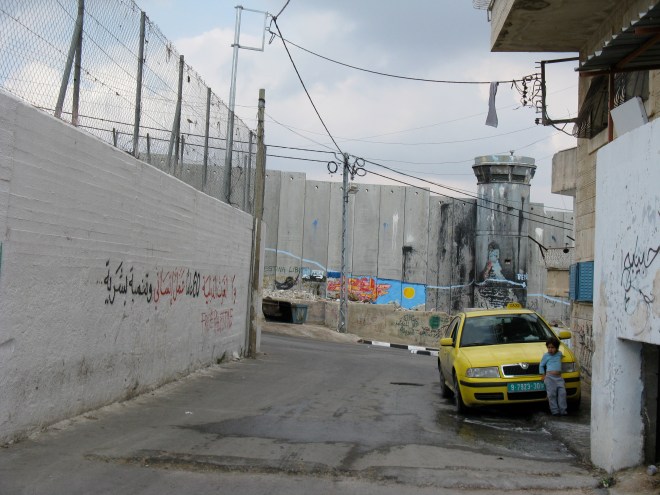
Now some of the people are beginning to cover the walls with stone over the concrete.  This provides better protection from bullets.  A machine gun can shoot through concrete. This is no idle concern.  Aida is surrounded by the Wall and the gun turrets are manned.  Moreover,  soldiers train in Aida, learning how to subdue a neighborhood, how to storm through interior walls between homes, how to blow up doors.  We were told that it is not uncommon for soldiers to shoot idly down into the camp for no reason, or to drive very fast down the narrow streets.  Children have absolutely no playground or green space in Aida, so they congregate in the streets to play; this is not safe for them, but they have few other alternatives.

The schools operate in shifts, because they cannot accommodate all the children in one shift.  They teach only the basic subjects because they lack the resources to do anything like music or art. So the Lajee Community Center provides some of this kind of programming for the children, teaching skills and providing recreational outlets.  The children collect money from home to buy fans or heaters for the classrooms (there is no central heating in Palestine, and it can go into the low 40s at night in winter and get very hot in summer.  The thick stone walls of buildings provide some insulation.)

I could write so much more.

After the tour of the camp, I made a quick turn-around and went to Beit Sahour to a nice place for plein air painting where I met several of my students.  I think there were close to the 20 who came, tho many who live far away had to leave early.  It was a bit of a brain warp to go so quickly from the tour  to painting in an olive grove.  But we had a lovely afternoon and enjoyed the view and the opportunity it presented.

A bright spot was seeing Arnie, and this evening we went out and had a nice dinner.  We’ll see each other again because tomorrow I will go to Nativity with the group in the afternoon and then to a restaurant with Dabke dancing (Palestinian dancing) in the evening.  In the afternoon we are going to have a lecture on non-violent responses to occupation.  I’m looking forward to joining a worship service tomorrow to have hope renewed.  Never mind that it will be in Arabic. Holy Communion needs no translation.

I’ve had trouble selecting a picture for today.  You need to see them all.  That’s not possible.  So here is my pick.

Blessings to all,

Chrischild in street at Aida Camp